
Your board can't manage what it can't see. Why payroll complaints need a central record.


Under the Closing the Loopholes amendments to the Fair Work Act, the bar for a serious contravention has been lowered from intentional underpayment to reckless underpayment. That single word change carries penalties of up to $4.95 million per contravention. And it shifts the compliance question from "did you mean to underpay?" to "what did you do to make sure you weren't?"
For most Australian employers, that question is harder to answer than it should be.
What reckless actually means
Employment lawyer Grace Brunton-Makeham (Partner, Makeham Flaherty) put it plainly during a recent Yellow Canary webinar: "The test of recklessness is going to be more around omissions rather than actions. It's not so much what the organisation is doing, it's what the organisation is not doing or what it's turning a blind eye to."
An organisation doesn't need to deliberately underpay anyone to be found reckless. It needs to have failed to investigate known issues, failed to check whether a single complaint reflects a systemic problem, or failed to keep a central record of payroll concerns raised across the business.
With 155 modern awards and thousands of enterprise agreements, payroll errors in Australia are common and often genuinely unintentional. But under the new framework, good intentions don't provide protection. Evidence of proactive steps does.
The visibility gap
The most common pattern, according to both Brunton-Makeham and David Morgan (Managing Director, Whistleblower Technologies, Veremark), is that payroll complaints get handled in isolation.
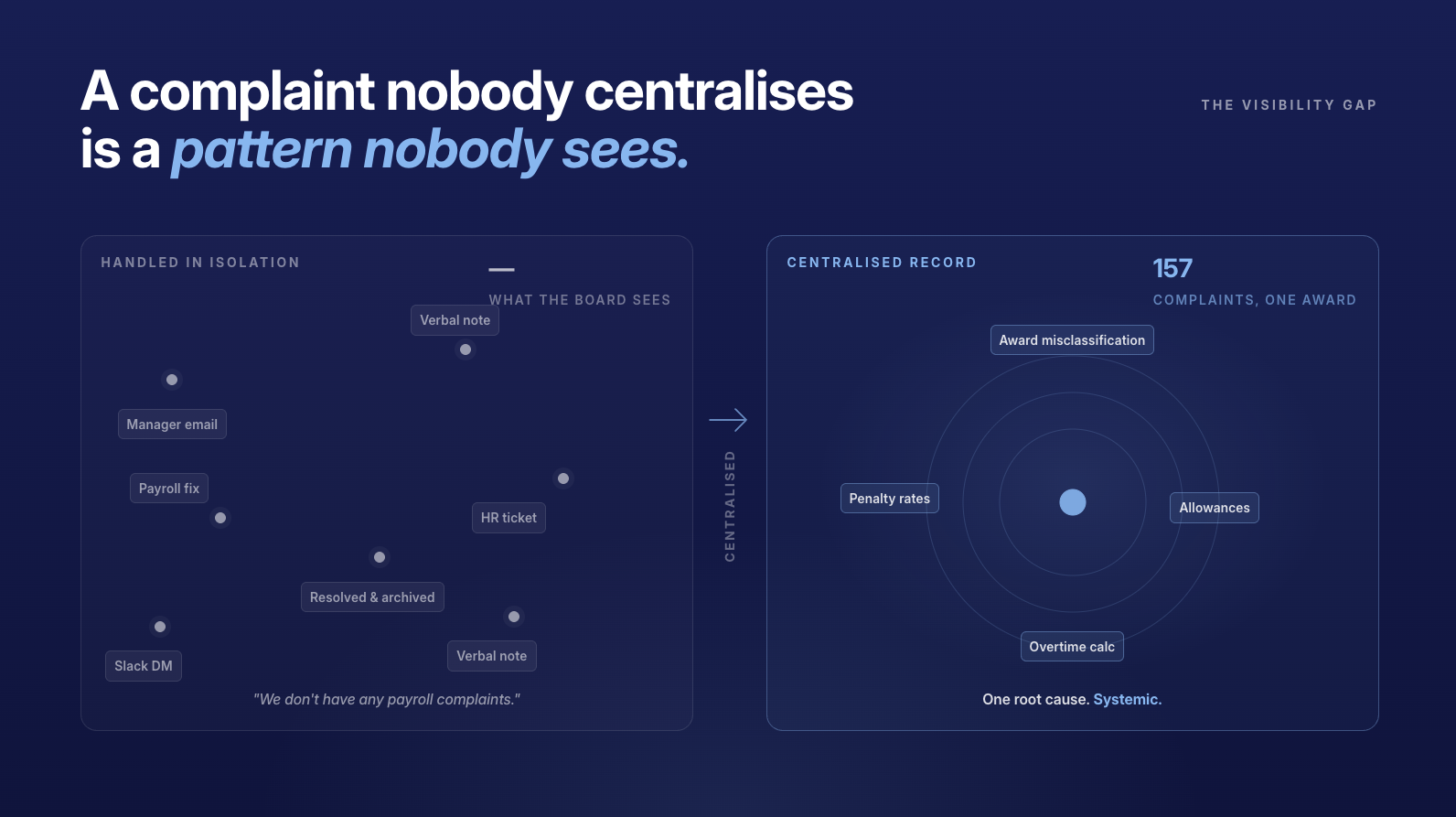
An employee raises a concern with their manager. It gets passed to payroll. The error is corrected. Nobody records it centrally, and nobody asks whether the same issue affects other employees paid under the same award or enterprise agreement.
"The board thinks, we don't have any payroll complaints, let me look at the risk register, we don't have anything like that," Brunton-Makeham said. "But actually, you've had hundreds over a few years. They've just been disparate."
Morgan described the same dynamic from a governance perspective. "The issues are often not dealt with holistically. They're dealt with in isolation. And so the quicker a business can join the dots together in terms of whether this is just an isolated issue or whether there are other people experiencing underpayment as well, the quicker the company can get on the front foot."
The gap between what the board can see and what the regulator will find is where recklessness lives.
Why internal channels alone aren't enough
Most organisations have some mechanism for employees to raise payroll concerns: their manager, HR, or the payroll team directly. These channels work for resolving individual errors, but they have structural limitations for identifying patterns.
Complaints raised verbally may never be documented. Emails to payroll get resolved and archived without being categorised. HR handles concerns on a case-by-case basis without tracking volume, type, or trend. The information exists somewhere in the organisation, but it never reaches the people responsible for assessing risk.
There's also the question of whether employees feel safe raising concerns internally at all. Morgan pointed to cases where employees used third-party speak-up channels because they didn't feel confident going directly to the business. "If you are an employee inside, you're being underpaid, but there is fear of speaking up because perhaps you have seen other people being treated unfairly when they've tried to raise similar concerns, where do you go?"
Purpose-built platforms like Veremark's whistleblowing solution address both problems: they give employees a safe, independent route to raise concerns, and they give the organisation a centralised system for capturing, categorising, and reporting on those concerns.
Building a balanced reporting framework
Morgan described what he calls a balanced reporting framework: internal pathways (managers, HR, payroll), the regulator pathway (Fair Work Ombudsman), and a third-party independent channel alongside both.
The value of the third-party channel isn't just that it captures complaints the other channels miss. It creates structured data. Complaints can be categorised by type and subcategory. Open matters can be tracked by duration and outcome. Trends can be reported to the executive team and board on a regular cycle.
"If we've got the third-party pathway alongside those other pathways in place, the organisation gets informed about problems early and they're able to rectify problems earlier," Morgan said. "They don't end up in a world of pain, which we unfortunately sometimes see when we're doing the investigation very late in the piece."
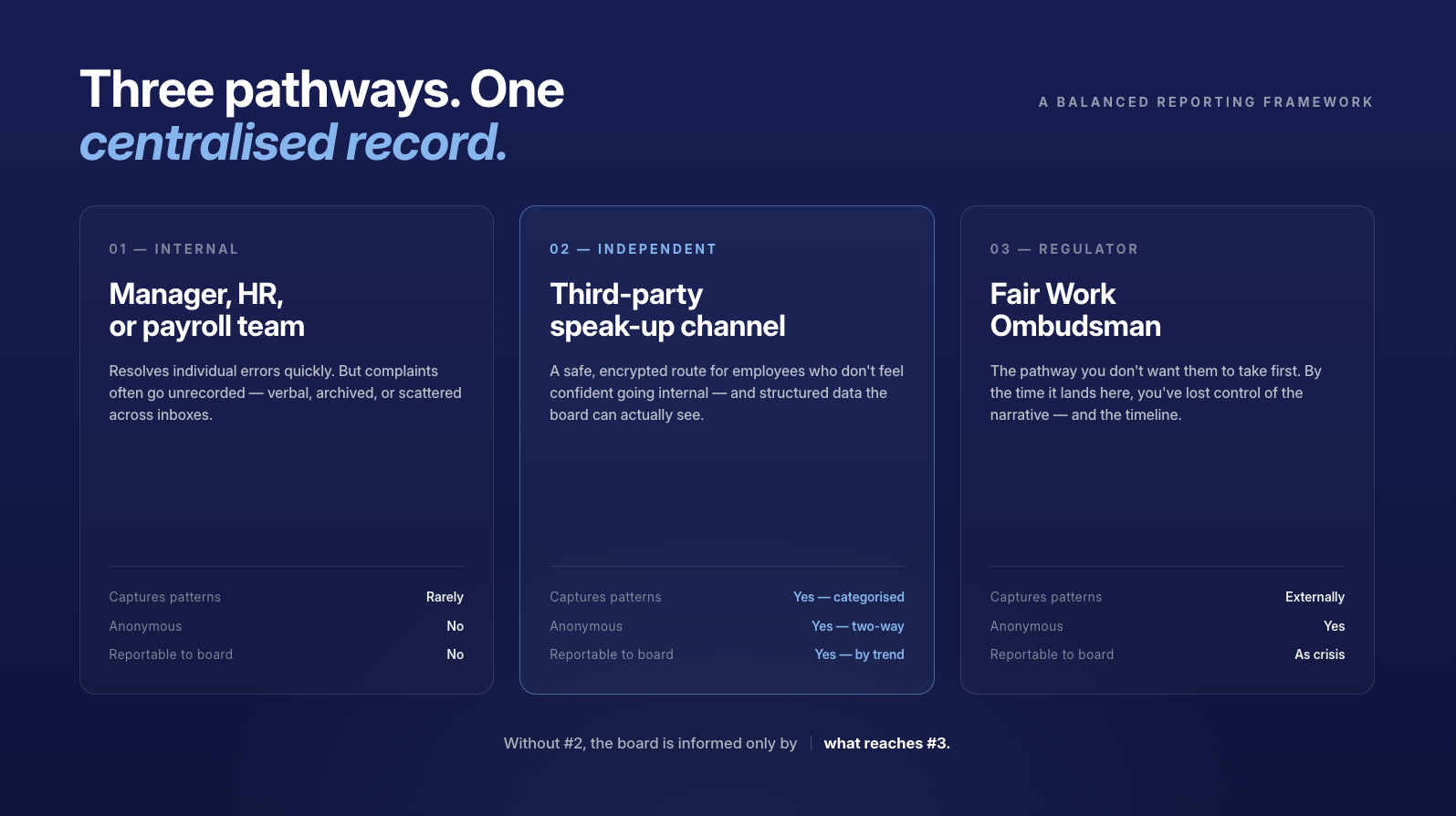
That reporting capability is what turns a speak-up channel from a compliance checkbox into a governance tool. It gives directors visibility over risk they would otherwise never see until a regulator, union, or journalist brought it to them.
How Veremark supports payroll compliance reporting
Veremark's speak-up platform is designed to close the visibility gap between frontline payroll complaints and board-level risk reporting.
Employees can report concerns anonymously through a secure, encrypted channel. Two-way anonymous messaging allows investigators to ask follow-up questions and provide support without compromising the reporter's identity. Guided reporting forms capture structured, categorised data from the outset, so complaints about payroll errors, award misclassification, or potential wage theft are tagged and trackable from day one.
For compliance and governance teams, the platform delivers centralised reporting across complaint type, status, duration, and outcome, giving directors and audit committees the data they need to assess payroll risk proactively rather than reactively.
Read more about Veremark's whistleblowing solution

The real cost of not knowing
An independent reporting channel doesn't eliminate payroll errors. Nothing will, given the complexity of the Australian system. What it does is ensure the organisation finds out about them first, responds to them systematically, and can demonstrate to a regulator that it was not reckless.
That's the difference between a contained issue and a crisis.
If you'd like to discuss how a speak-up channel fits into your organisation's payroll compliance framework, book a consultation with David Morgan.
This article draws on a Yellow Canary webinar, "When an employee speaks up: the first 90 days of an underpayment issue," featuring David Morgan (Veremark), Grace Brunton-Makeham (Makeham Flaherty), and Marcus Zeltzer (Yellow Canary). Watch the full session on demand.


.png)
FAQs

This depends on the industry and type of role you are recruiting for. To determine whether you need reference checks, identity checks, bankruptcy checks, civil background checks, credit checks for employment or any of the other background checks we offer, chat to our team of dedicated account managers.
Many industries have compliance-related employment check requirements. And even if your industry doesn’t, remember that your staff have access to assets and data that must be protected. When you employ a new staff member you need to be certain that they have the best interests of your business at heart. Carrying out comprehensive background checking helps mitigate risk and ensures a safer hiring decision.
Again, this depends on the type of checks you need. Simple identity checks can be carried out in as little as a few hours but a worldwide criminal background check for instance might take several weeks. A simple pre-employment check package takes around a week. Our account managers are specialists and can provide detailed information into which checks you need and how long they will take.
All Veremark checks are carried out online and digitally. This eliminates the need to collect, store and manage paper documents and information making the process faster, more efficient and ensures complete safety of candidate data and documents.
In a competitive marketplace, making the right hiring decisions is key to the success of your company. Employment background checks enables you to understand more about your candidates before making crucial decisions which can have either beneficial or catastrophic effects on your business.
Background checks not only provide useful insights into a candidate’s work history, skills and education, but they can also offer richer detail into someone’s personality and character traits. This gives you a huge advantage when considering who to hire. Background checking also ensures that candidates are legally allowed to carry out certain roles, failed criminal and credit checks could prevent them from working with vulnerable people or in a financial function.
Trusted by the world's best workplaces


APPROVED BY INDUSTRY EXPERTS
.png)
.png)


and Loved by reviewers


Transform your hiring process
Request a discovery session with one of our background screening experts today.