
Why Didn’t the Investigation Resolve the Alleged $1.15 Million Fraud?


The Terra Com judgment shows how a well-resourced corporate investigation can leave serious allegations of misconduct unanswered. If the same report landed on your desk, would anything be different?
A whistleblower alleged the company was manipulating coal quality certificates to overcharge customers. An external investigation identified $1.15 million in financial benefit from the very inconsistencies he’d flagged. The whistleblower was never interviewed. The investigation concluded no wrongdoing was found. Five years later, the question was still being tested in the Federal Court.
The harder question isn’t what happened at TerraCom. It’s what an investigation inside your own organisation would do differently if the same disclosure landed tomorrow. Would it ask more? Would it answer more?
What the whistleblower alleged
Coal from the Blair Athol mine was tested three times on its way to customers — at the mine, at the port (a preliminary Shipping Analysis Report) and again before loading (the final Certificate of Analysis). The final certificate set the invoice price.
The whistleblower alleged those final certificates were amended upward, showing higher net calorific value than earlier testing supported. Higher certified NCV meant higher prices per tonne, and borderline shipments cleared contractual quality thresholds that might otherwise have triggered rejection.
In plain terms, the allegation was that customers were being overcharged and contractually deprived of their right to refuse, through a deliberate misrepresentation of the product being sold.
Why this looked like corruption
If the whistleblower was right, this wasn’t a one-off error. It was a systematic misrepresentation affecting multiple shipments and multiple customers, with a consistent financial benefit to the seller. The profile looked like fraud against customers, potentially misleading the market, and a sustained failure of internal controls.
The seriousness of the allegation is the reason the investigation mattered. Any organisation facing a disclosure of this profile is obliged to test it properly.
What the investigation found
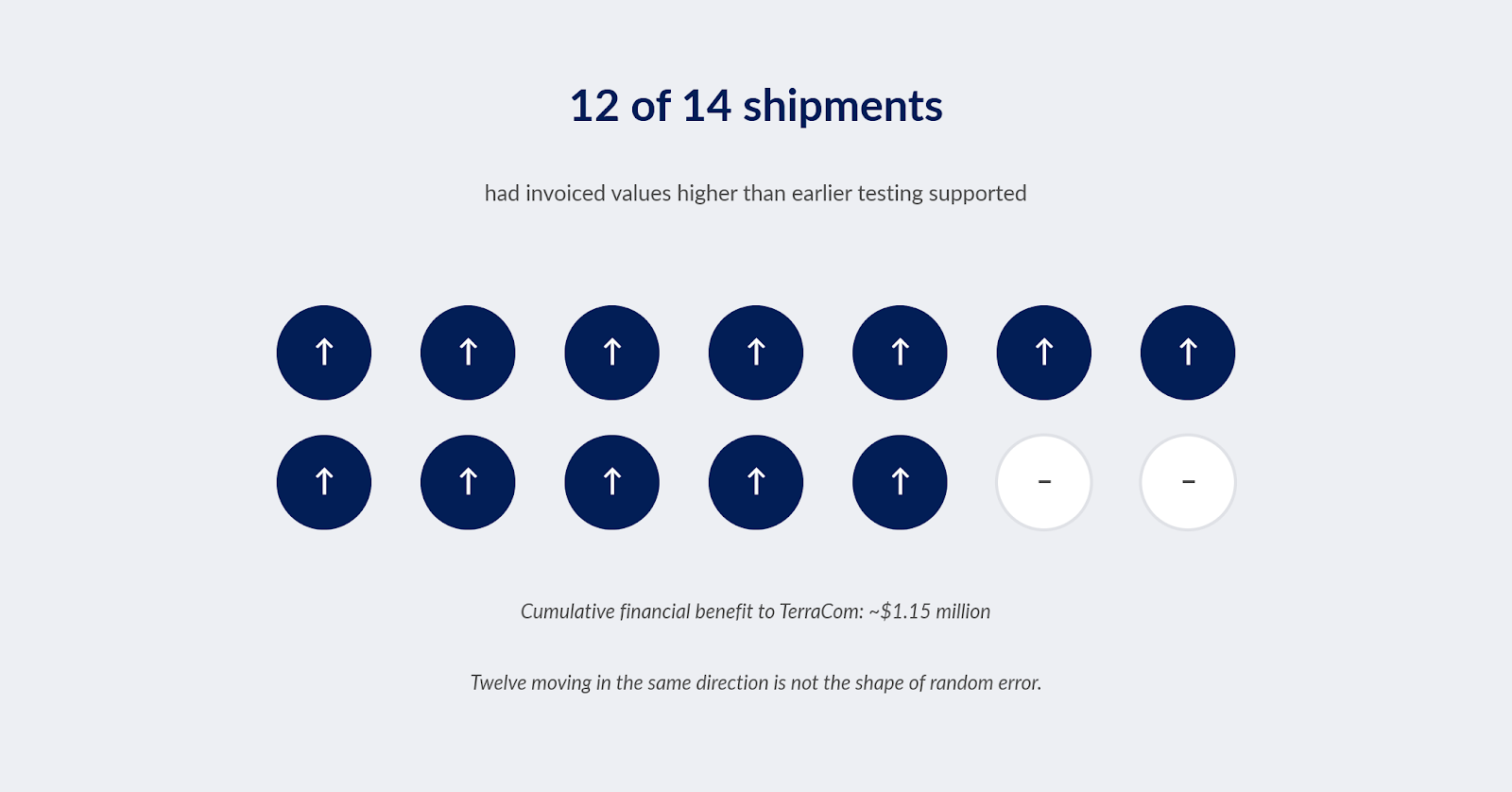
PwC was engaged. It reviewed 14 shipments. In 12, the invoiced NCV was higher than earlier testing had shown. The cumulative financial benefit to TerraCom came to roughly $1.15 million. Some shipments could have been rejected outright if the preliminary numbers had held.
PwC noted, correctly, that coal quality can vary between tests — moisture, handling, sampling. What it didn’t explain was why the variance so consistently favoured the seller. Twelve of fourteen moving in the same direction is not the shape of random error. It is the shape of a finding that needs to be explained, one way or the other.
What the investigation didn’t do
PwC didn’t interview the whistleblower. The report expressly acknowledged it didn’t have access to him. The person with direct knowledge of the alleged conduct was never asked to explain what he had seen.
PwC didn’t interview ALS, the laboratory that issued the certificates. ALS was later found to have its own internal issues, including certificates amended manually without documented justification. Whether any of that connected back to TerraCom was never tested. Former employees central to the allegations weren’t interviewed either.
What remained was an inquiry built almost entirely on internal documents and interviews with current management. Procedurally structured. Substantively constrained.
“An investigation that never interviews the whistleblower cannot rigorously collate and test the whistleblower’s information. The conclusion is often inconclusive, which often helps nobody.”
David Morgan, Managing Director, Veremark Whistleblower Technology Solutions
“No wrongdoing found” was absence of evidence, not a clean bill
TerraCom’s investigation concluded no wrongdoing was found. That conclusion reflects an absence of evidence, not a finding that nothing happened. The Federal Court picked up on exactly this, noting that the cause of the NCV discrepancies was never resolved.
That distinction matters. A report that says “no wrongdoing found” after failing to interview key people who could have provided new information is not proof of compliance. It is proof that the investigation was scoped in a way that made a complete finding impossible.
Five years in court, because the question wasn’t answered earlier
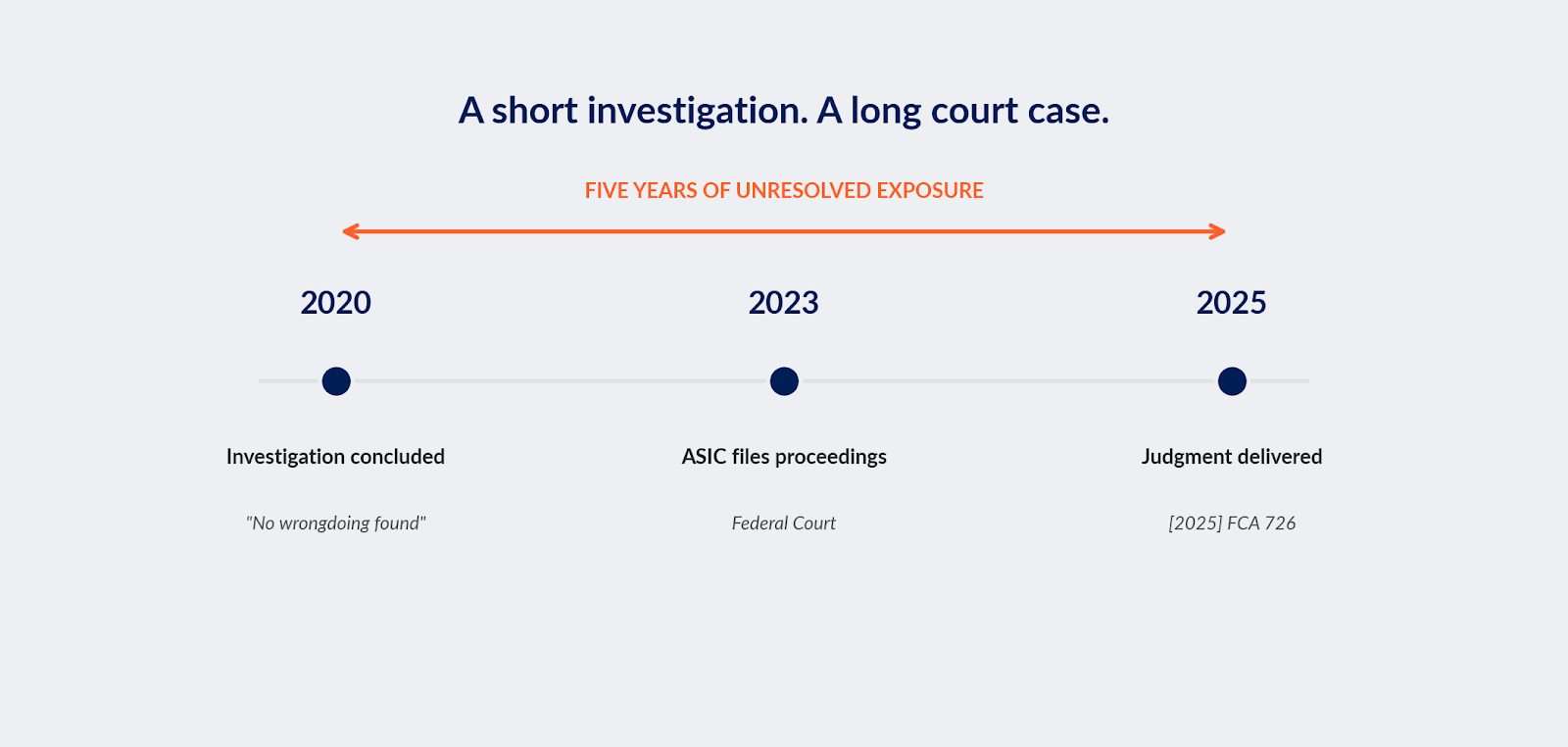
The TerraCom investigation closed in 2020. ASIC filed proceedings in 2023. The Federal Court delivered judgment in July 2025. For years, the company and its officers lived inside an unresolved question, through regulator inquiries, litigation, discovery and executive testimony. The Court ultimately dismissed the ASIC case. The proceedings themselves were the consequence. Legal costs, executive time, reputational drag, customer doubt.
An investigation with proper access at the time would either have vindicated the company cleanly, or surfaced the real issue early, when it could still be fixed internally. Instead, the limitations of the investigation became what the regulator was able to probe.
What a credible investigation process actually does
It puts a rigorous scope around the disclosure, so the information is objectively tested to determine if there is evidence that supports the whistleblowers version of events or not. The approach should be balanced and all parties treated fairly and respectfully. The threshold for civil matter is the balance of probabilities, but the evidential threshold gets higher when serious misconduct is being considered as a finding which could lead to dismissal or a regulatory breach.
Most investigations don’t fail because the facts are unknowable. They fail because the assessment was not conducted well, and it leads to a limited or incomplete investigation. People are not interviewed, questions are not asked, facts are not collated and the conclusions are incomplete. We will never know which way the Terra Com case may have landed if more enquiries were conducted, all we do know is that many stakeholders were impacted badly and the case went on for many years.
A checklist for the next investigation report that lands on your desk
Before you accept the conclusion, run through four questions:
- Was the person who raised the concern interviewed?
- Were all witnesses who could corroborate or contradict the information interviewed?
- Does the person that is conducting the investigation have the right skill-set?
- Did management ensure strong independence in how the investigation was designed, delivered and reported?
A “no” to any of them narrows the likelihood of a satisfactory investigation process.
If any of these questions made you pause about an investigation you’ve signed off on recently, or one your organisation is running now, the gap is worth a conversation before a regulator makes it one for you.
Veremark partners with organisations on whistleblowing systems that capture, protect and properly test what is disclosed. Get on a call with us.
{{whistleblowing-cta="/components"}}


.png)
FAQs

This depends on the industry and type of role you are recruiting for. To determine whether you need reference checks, identity checks, bankruptcy checks, civil background checks, credit checks for employment or any of the other background checks we offer, chat to our team of dedicated account managers.
Many industries have compliance-related employment check requirements. And even if your industry doesn’t, remember that your staff have access to assets and data that must be protected. When you employ a new staff member you need to be certain that they have the best interests of your business at heart. Carrying out comprehensive background checking helps mitigate risk and ensures a safer hiring decision.
Again, this depends on the type of checks you need. Simple identity checks can be carried out in as little as a few hours but a worldwide criminal background check for instance might take several weeks. A simple pre-employment check package takes around a week. Our account managers are specialists and can provide detailed information into which checks you need and how long they will take.
All Veremark checks are carried out online and digitally. This eliminates the need to collect, store and manage paper documents and information making the process faster, more efficient and ensures complete safety of candidate data and documents.
In a competitive marketplace, making the right hiring decisions is key to the success of your company. Employment background checks enables you to understand more about your candidates before making crucial decisions which can have either beneficial or catastrophic effects on your business.
Background checks not only provide useful insights into a candidate’s work history, skills and education, but they can also offer richer detail into someone’s personality and character traits. This gives you a huge advantage when considering who to hire. Background checking also ensures that candidates are legally allowed to carry out certain roles, failed criminal and credit checks could prevent them from working with vulnerable people or in a financial function.
Trusted by the world's best workplaces


APPROVED BY INDUSTRY EXPERTS
.png)
.png)


and Loved by reviewers


Transform your hiring process
Request a discovery session with one of our background screening experts today.