
What really happens during a background check


Most people only encounter background screening once or twice in a career, usually right before starting a new job. The process can feel opaque, even though the mechanics behind it are pretty straightforward.
This article is for the people being checked. What follows is how a check actually works, why it's designed the way it is, and how to get through it with less friction.
How a check is designed: the employer and the screening company share the work
A background check usually involves two organisations. The company hiring you, and the background screening provider they've appointed to carry out the verifications.
The split matters, because it explains why different candidates can have very different experiences from the same provider.
The employer designs the check. They decide what needs verifying for the role, taking into account the responsibilities of the job, the industry, and the regulations they sit under. They then bring in a background screening provider to carry out the actual verifications. The screening provider doesn't decide what goes into the check. We carry out the work the employer has commissioned, to the standard the employer (or their regulator) requires.
This shared model exists for a reason. The employer knows what the role demands. The screening provider knows how to verify it to a standard that holds up to scrutiny later. Each side does the part it's best placed to do.
The Professional Background Screening Association's annual survey puts global adoption at around 93% of organisations running some form of pre-employment screening. The shape of those programmes varies enormously, which is part of why two candidates in different roles can come away with very different impressions of the same provider.
Why some checks ask for more than others
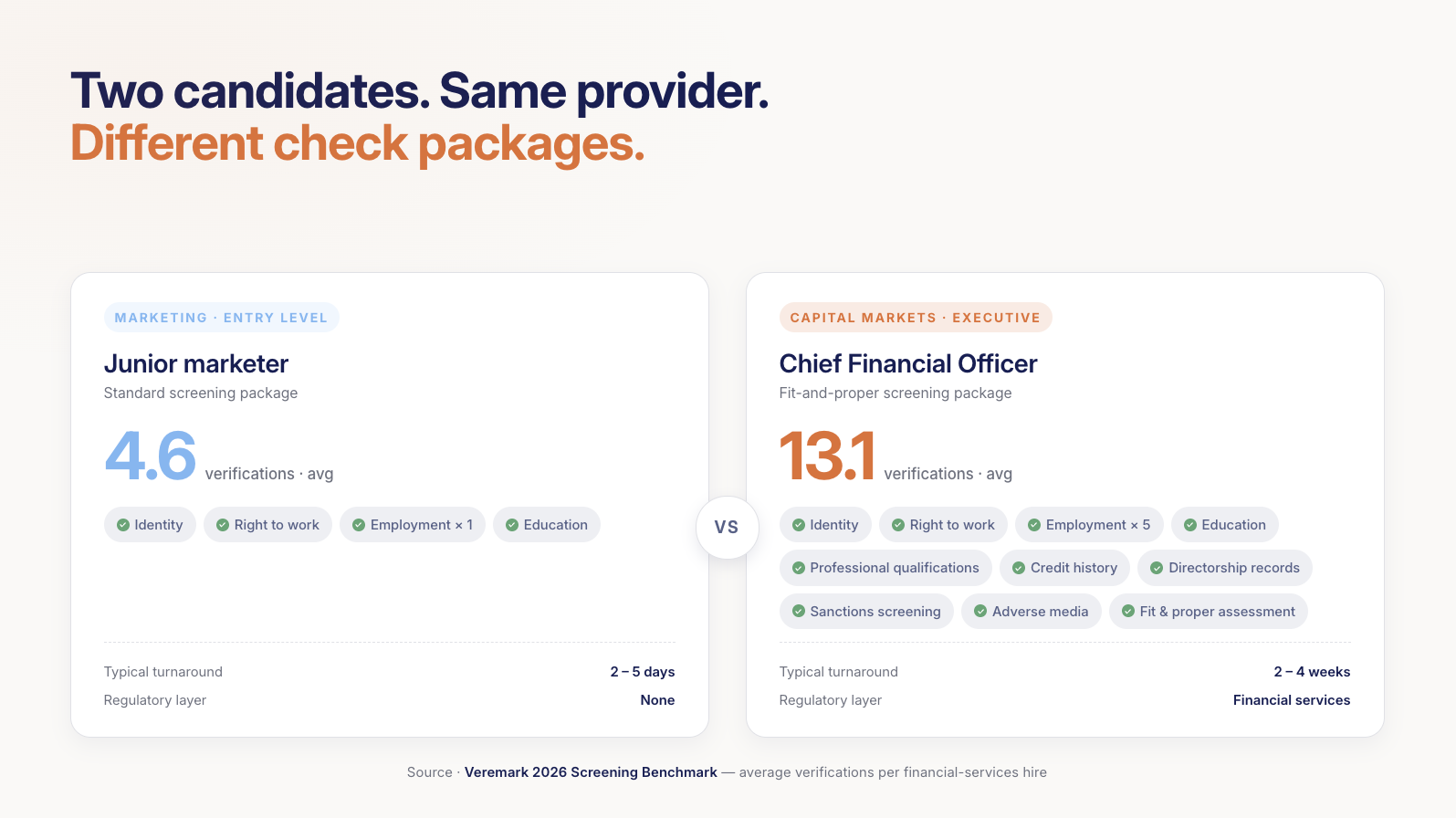
A junior hire and a CFO won't go through the same check. That's the system working as intended.
Someone joining as an entry-level marketer might only need identity confirmation, right to work, and a single employment reference. The whole thing can wrap up in days. A CFO at the same company is likely to need identity, right to work, multiple employment references, education and professional qualifications, credit history, directorship records, sanctions screening, adverse media, and a fit-and-proper assessment. The depth reflects the responsibility of the role.
Veremark's 2026 Screening Benchmark put the average financial services hire at 4.6 verifications per check, with capital markets roles averaging 13.1. Healthcare, government, and roles working with vulnerable people sit on similar curves, shaped by the rules and risks of those sectors.
Each verification carries its own minimum requirements. Identity needs government-issued ID. Education needs the specific course, dates, and institution. Employment needs dates, titles, and a verifier at the company who can confirm the details. The reason heavier check packages ask for documents, contact names, and reference codes is that every verification has its own evidence requirements that can't be skipped without leaving a gap in the final report.
It rarely feels neat from the candidate's side. Each check is really a collection of smaller verifications running in parallel, each with its own moving parts, all held to the same standard.
How verification actually works
There's a common mental image of background screening that involves databases being raided, employer systems being trawled, and long lists of contacts being called. The actual mechanics are calmer than that.
For education checks, screening companies contact the university or awarding body directly, through their official verification channel. Most institutions have a dedicated team that handles these requests on their own queue and timeline.
For employment checks, the contact is the HR team or a named verifier at the previous employer. The conversation is narrow, confirming dates, title, and sometimes reason for leaving. It's the same kind of reference call most employers make themselves when hiring.
For identity, right to work, and criminal record checks, screening providers go through official sources. Government databases, police agencies, or licensed bureaus, depending on the jurisdiction.
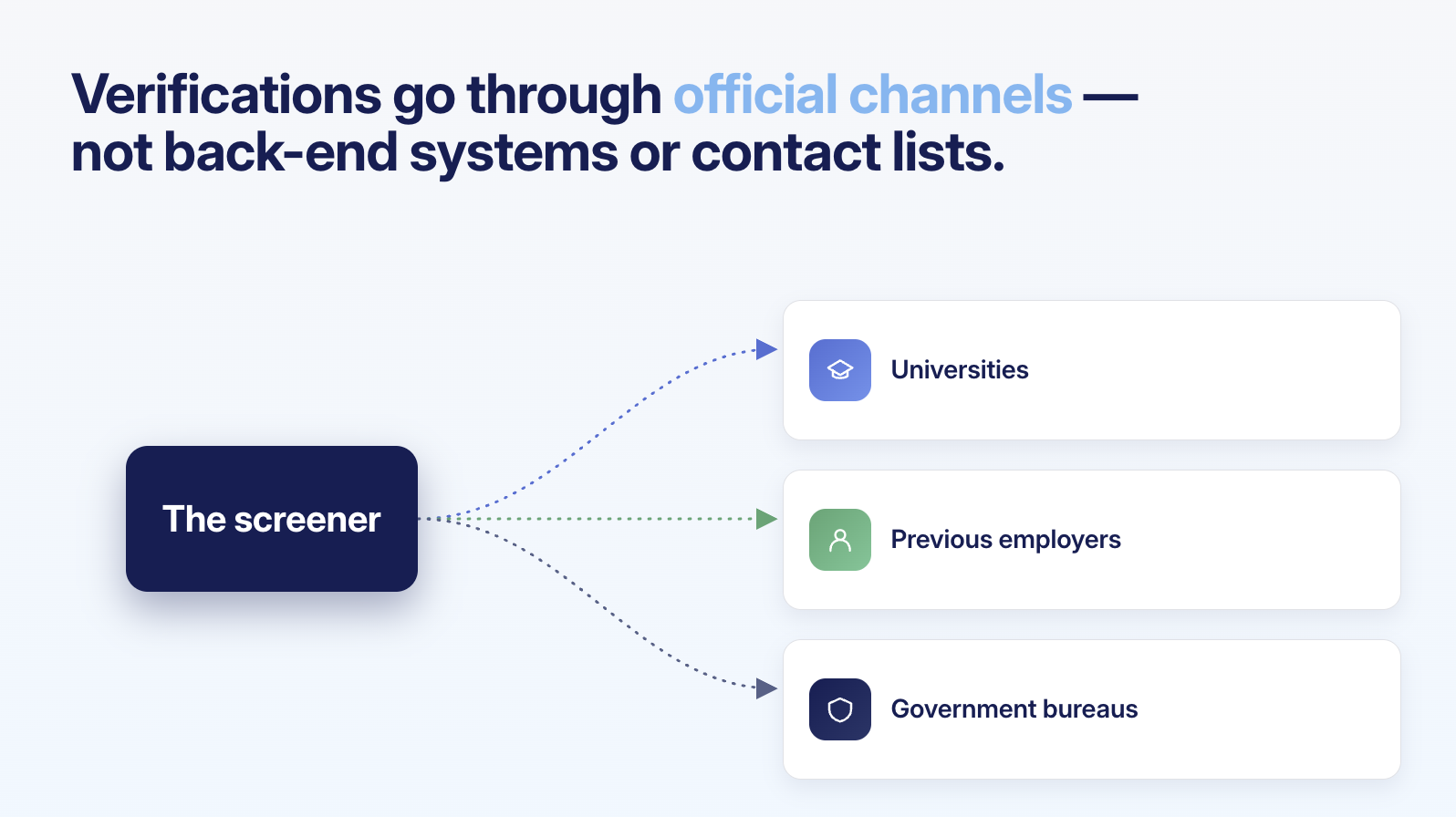
There's a reason verification goes through these official channels rather than a contact list provided by the candidate. It's there to make the result trustworthy. Independent CV research from StandOut CV in 2024 found that 64% of candidates had misrepresented themselves on their CV, with altered employment dates the most common form (50%) and inflated responsibilities close behind (32%). Resume.org's research adds another layer: 96% of people who knowingly lied on their applications said they were never found out.
These numbers explain why verification has to be independent of the candidate. If the system relied on candidate-provided contacts, the dishonest cases would slide through, and the value of the check would collapse for the honest majority. The same standard applies to everyone, which is part of what makes a clean verified report meaningful when you do come out the other side.
Why things take time
A background check is a relay between several organisations, and most of the wait is in the handoffs.
The screening provider has its own process. We assess what's been submitted, route each verification to the right place, follow up where needed, and handle anything ambiguous. Each verifier on the other end has their own process too. Universities have dedicated verification teams running on their own queues. Employers' HR teams take requests alongside their day-to-day work. Government bodies and police agencies have their own backlogs.
When a verification request lands with one of these parties, it sits inside their process until they're ready to respond. Screening providers can chase, follow up, and escalate. We can't override another organisation's internal timeline.
This is why completion windows are usually quoted as ranges. The estimate reflects the typical spread of third-party response times, layered on top of the screening provider's own work. Most of the provider's part of the job happens within 24 to 48 hours. The rest of the clock is the wait.

For candidates, this matters in one practical way. If your start date is close to the date the check was opened, there's a reasonable chance the two will land on top of each other. That's worth raising with your new employer early, since they're the only party who can decide whether to adjust timelines.
Why your data doesn't stay forever
This question usually comes up after the fact. Why can't I log in and download my report a few months later?
Background check data is some of the most sensitive personal information you'll share in your working life, and it's protected accordingly. Data protection rules in whichever country the check was run in (GDPR in the UK and EU, the Privacy Act in Australia, the PDPA in Singapore, and similar regimes elsewhere) all share the same principle of data minimisation. Personal data shouldn't be held longer than needed for the purpose it was collected for.
Guidance from the International Association of Privacy Professionals reinforces the point for screening data specifically. It sits at the sensitive end of the spectrum, and shouldn't be retained beyond its operational use without a clear reason.
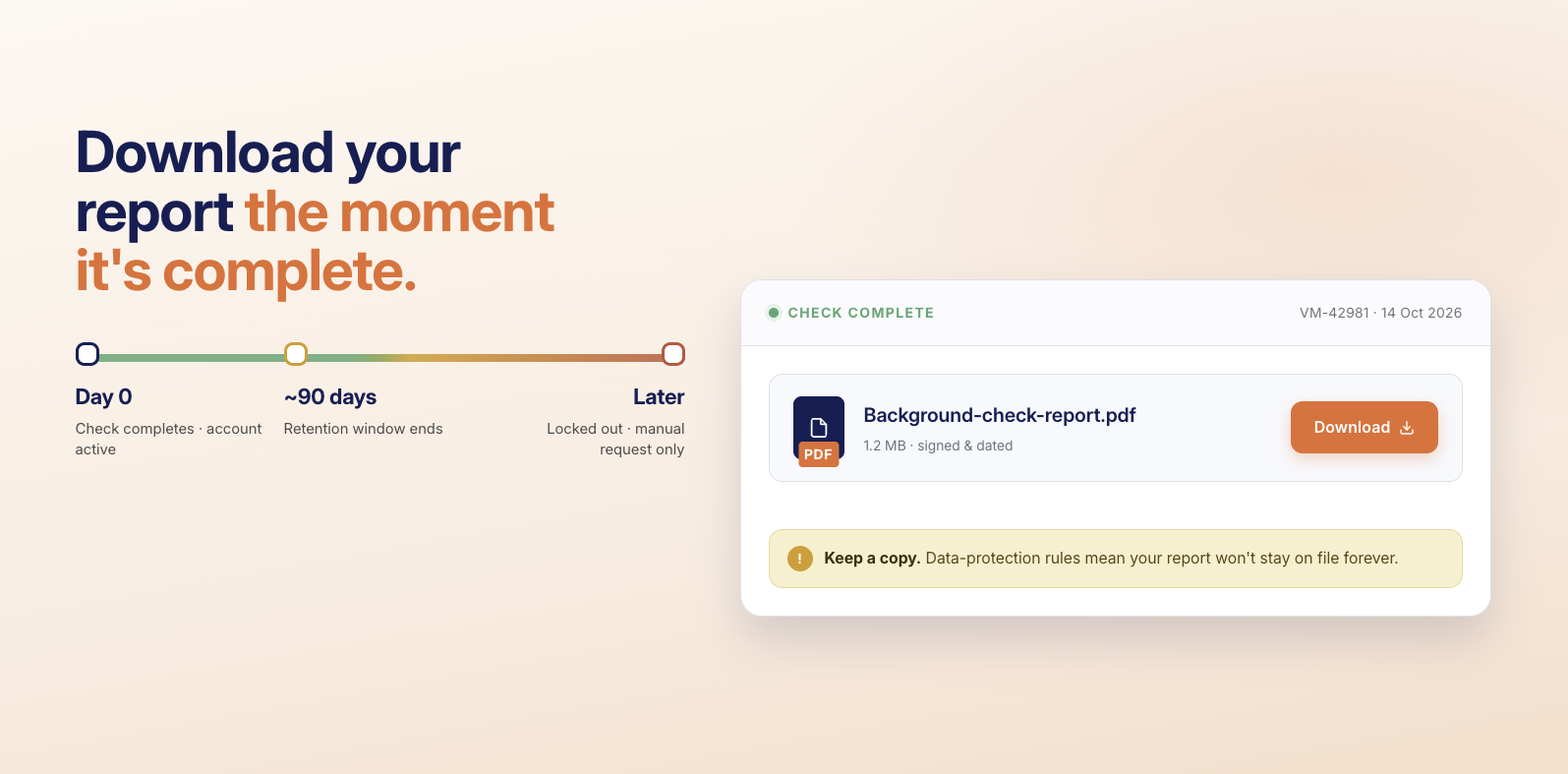
In practice, this means screening providers set retention periods, after which candidate data is removed from active systems. This is how the system protects you. Every reputable screening provider operates under the same retention principle.
The trade-off is that candidates who don't download their report while their account is active can find themselves locked out later. The simple advice: when the check completes, download your report and keep a copy. You own that file, and a future employer can sometimes accept it as a clean record without ordering a new check.
If your account has expired and you need your report back, the screening provider can usually still help, but the route is a manual request rather than a login.
How to get through the process more easily
A few things tend to help.
- Ask your employer what check package has been ordered, and what's included. They should be able to tell you. If they can't, the screening provider can usually walk you through it once the check is open.
- Get your documents together early. Old employment dates, pay slips, academic transcripts, address history. Having these to hand at the start shaves days off the end.
- Download your report the moment it's complete. Don't wait until the next role. Keep it somewhere you'll find it again.
- If something feels off during the process, raise it early with both the employer and the screening provider. Most issues come from small mismatches in dates or names that can be cleared up in a single email if they're caught in time.
- If you're not sure who to ask, the screening provider is usually a good starting point. They can tell you which questions belong with them and which belong with the employer.
The point of all this
Background screening is part of how trust gets established in modern hiring. It's how an employer can be confident that the person they've offered the role to is who they say they are, has done what they say they've done, and can be relied on with the responsibilities of the job. It also works in honest candidates' favour. A clean verified report carries a weight that an unverified CV doesn't.
The process can feel impersonal at points, especially when you're in the middle of it with a start date approaching. The mechanics exist to answer one question: is this person who they say they are. The shape of it tends to feel less opaque once the moving parts are visible.


.png)
FAQs

This depends on the industry and type of role you are recruiting for. To determine whether you need reference checks, identity checks, bankruptcy checks, civil background checks, credit checks for employment or any of the other background checks we offer, chat to our team of dedicated account managers.
Many industries have compliance-related employment check requirements. And even if your industry doesn’t, remember that your staff have access to assets and data that must be protected. When you employ a new staff member you need to be certain that they have the best interests of your business at heart. Carrying out comprehensive background checking helps mitigate risk and ensures a safer hiring decision.
Again, this depends on the type of checks you need. Simple identity checks can be carried out in as little as a few hours but a worldwide criminal background check for instance might take several weeks. A simple pre-employment check package takes around a week. Our account managers are specialists and can provide detailed information into which checks you need and how long they will take.
All Veremark checks are carried out online and digitally. This eliminates the need to collect, store and manage paper documents and information making the process faster, more efficient and ensures complete safety of candidate data and documents.
In a competitive marketplace, making the right hiring decisions is key to the success of your company. Employment background checks enables you to understand more about your candidates before making crucial decisions which can have either beneficial or catastrophic effects on your business.
Background checks not only provide useful insights into a candidate’s work history, skills and education, but they can also offer richer detail into someone’s personality and character traits. This gives you a huge advantage when considering who to hire. Background checking also ensures that candidates are legally allowed to carry out certain roles, failed criminal and credit checks could prevent them from working with vulnerable people or in a financial function.
Trusted by the world's best workplaces


APPROVED BY INDUSTRY EXPERTS
.png)
.png)


and Loved by reviewers


Transform your hiring process
Request a discovery session with one of our background screening experts today.