
We analysed close to half a million background checks. Here's what we learned.


When you process screening checks at volume, across industries, for thousands of organisations, certain patterns become hard to ignore. Patterns that aren't visible at the level of individual hires or single client accounts, but emerge clearly when the data is large enough. These are five things from the data that we think are worth paying attention to.
Screening depth varies fivefold across industries, and most organisations have never benchmarked theirs
Capital Markets averages 13.1 checks per hire. Business Services averages 2.5. Both are large, mature industries. The difference reflects what each sector's risk environment demands: Capital Markets operates where every hire can access client assets and trading systems, and the screening depth maps to the consequences of getting one wrong.
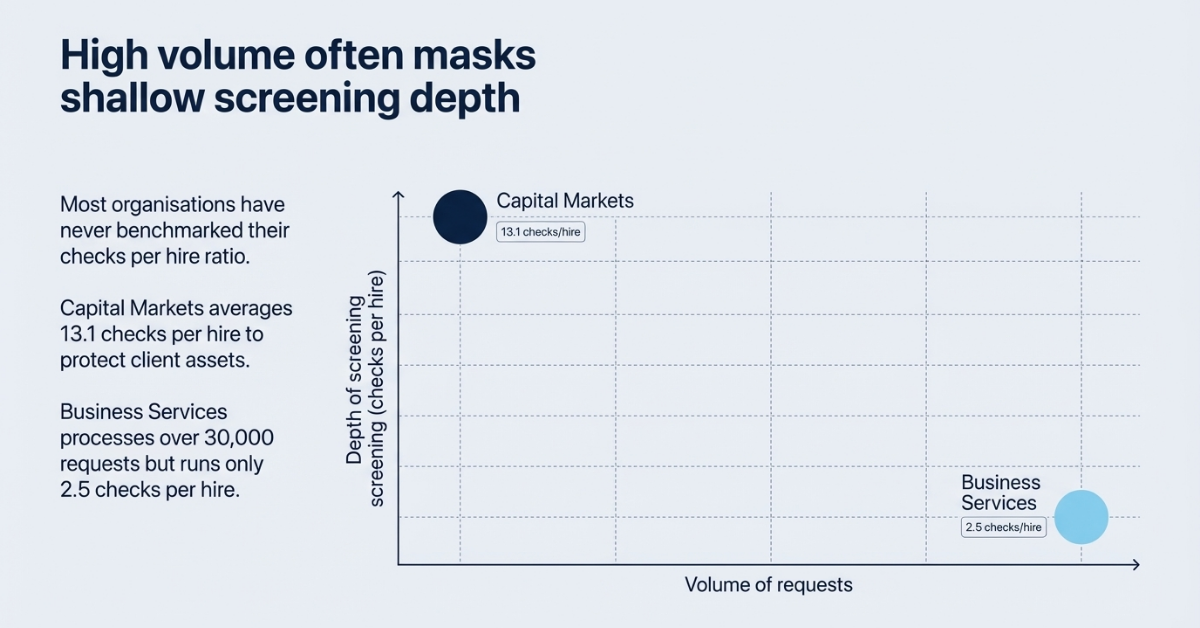
Business Services is interesting for a different reason. It processes the highest volume of screening requests of any vertical, more than Financial Services, more than Technology, more than anyone. But it runs the fewest checks per candidate. A high-volume programme and a deep programme are different things, and it's possible to look busy while doing relatively little per hire.
Most organisations have never compared their checks-per-hire ratio against an external number, because there hasn't been one to compare against. The benchmarks in the report are designed to change that.
Every industry screens differently, and the differences are larger than expected
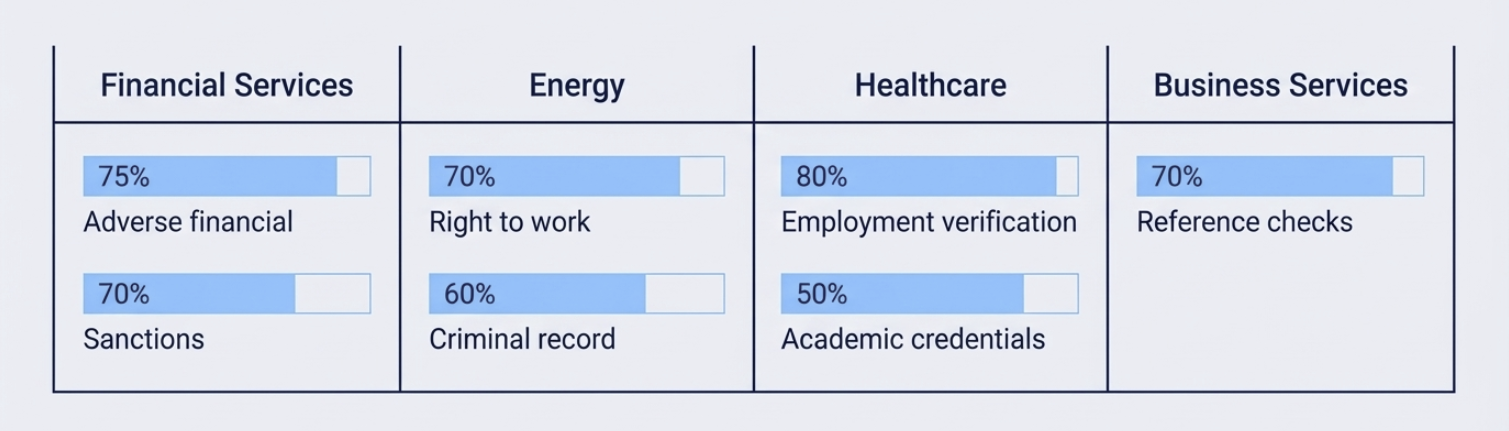
Financial Services is weighted towards adverse financial history and sanctions checks. Energy/Industrial is dominated by right to work (19.9% of volume) and criminal record checks (20.9%). Healthcare leads with employment verification and academic credentials. Business Services runs reference checks at 17.3% of volume, more than double any other industry.
Each of these profiles traces to something specific. The FCA's fit-and-proper requirements shape Financial Services. The Home Office's tripling of illegal employment penalties in February 2024 shapes Energy. Clinical competence risk shapes Healthcare. A screening programme that looks the same regardless of which industry it sits in probably isn't configured for any of them.
The checks that catch the most common discrepancies are the ones most programmes treat as optional

Database checks (sanctions, criminal record, ID, financial history, right to work) account for 58% of all screening volume. In Financial Services, 80%. These checks flag discrepancies under 1% of the time.
Education checks flag at 21.1%. Employment checks at 15.3%. CV gap checks at 51.7%.
The database layer is testing whether a person's identity appears on a register. The verification layer is testing whether a candidate told the truth about their career. Both matter. The difference is that the verification layer catches discrepancies at rates that are 15 to 50 times higher than the database layer, and in many standard packages, those verification checks sit in the add-on tier rather than the default.
A programme can look thorough, heavy on sanctions and criminal checks, while having almost no detection capability in the area where discrepancies are most concentrated.
52% of CV gap checks flag something, and almost nobody includes them
CV gap analysis identifies unexplained breaks of six months or more in a candidate's employment history. It has the highest discrepancy rate of any check type in the dataset, at 51.7%.
Some of those gaps are benign: parental leave, travel, study. Others mask a role that ended badly, a termination removed from the CV, or a period the candidate chose to leave out. The check surfaces the gap. What it means gets determined in the conversation that follows.
The reason most organisations don't run it is practical. It depends on a completed employment timeline, which means it can't run until employment checks are done. It adds time and cost. And because no regulation specifically mandates it, it falls into the optional category.
The result is that the most productive check in the entire dataset, the one that flags an issue more than half the time, is the one least likely to be included. For senior and regulated roles, where a fabricated or embellished career carries the most consequence, that trade-off is worth revisiting.
81% of employers screen at the point of hire and never again
The monthly data tracks hiring cycles almost exactly. Financial Services rises 53% between January and December. Business Services peaks in September and falls 62% by December. Retail spikes 40x in August for seasonal hiring.
Screening is an event on the hiring calendar. When hiring is active, screening is active. When hiring slows, it stops. The workforce that's already through the door receives no ongoing verification.
People's circumstances change. Financial distress, legal proceedings, lapsed certifications, expired immigration permissions, new sanctions listings. The FCA already requires annual reassessment of fitness and propriety under SM&CR, and the December 2025 guidance on non-financial misconduct expanded what firms need to assess. The Home Office expects ongoing right to work verification for time-limited permissions. The regulatory direction is clear, and 81% of organisations aren't there yet.
The full picture
The Veremark Screening Benchmark 2026 covers all five areas above in depth, with industry-level screening profiles, discrepancy rates across check types, regulatory mapping, and a practical framework for assessing where a programme's gaps sit.
{{the-2026-veremark-screening-benchmark="/components"}}


.png)
FAQs

This depends on the industry and type of role you are recruiting for. To determine whether you need reference checks, identity checks, bankruptcy checks, civil background checks, credit checks for employment or any of the other background checks we offer, chat to our team of dedicated account managers.
Many industries have compliance-related employment check requirements. And even if your industry doesn’t, remember that your staff have access to assets and data that must be protected. When you employ a new staff member you need to be certain that they have the best interests of your business at heart. Carrying out comprehensive background checking helps mitigate risk and ensures a safer hiring decision.
Again, this depends on the type of checks you need. Simple identity checks can be carried out in as little as a few hours but a worldwide criminal background check for instance might take several weeks. A simple pre-employment check package takes around a week. Our account managers are specialists and can provide detailed information into which checks you need and how long they will take.
All Veremark checks are carried out online and digitally. This eliminates the need to collect, store and manage paper documents and information making the process faster, more efficient and ensures complete safety of candidate data and documents.
In a competitive marketplace, making the right hiring decisions is key to the success of your company. Employment background checks enables you to understand more about your candidates before making crucial decisions which can have either beneficial or catastrophic effects on your business.
Background checks not only provide useful insights into a candidate’s work history, skills and education, but they can also offer richer detail into someone’s personality and character traits. This gives you a huge advantage when considering who to hire. Background checking also ensures that candidates are legally allowed to carry out certain roles, failed criminal and credit checks could prevent them from working with vulnerable people or in a financial function.
Trusted by the world's best workplaces


APPROVED BY INDUSTRY EXPERTS
.png)
.png)


and Loved by reviewers


Transform your hiring process
Request a discovery session with one of our background screening experts today.