
The End of the Grace Period: Australia’s New Positive Duty Standards


Could your organisation demonstrate to the AHRC tomorrow that you're actively preventing sexual harassment? It’s no longer enough to just have policies in place; you must prove you’ve identified risks, implemented controls, and have evidence your systems actually work.
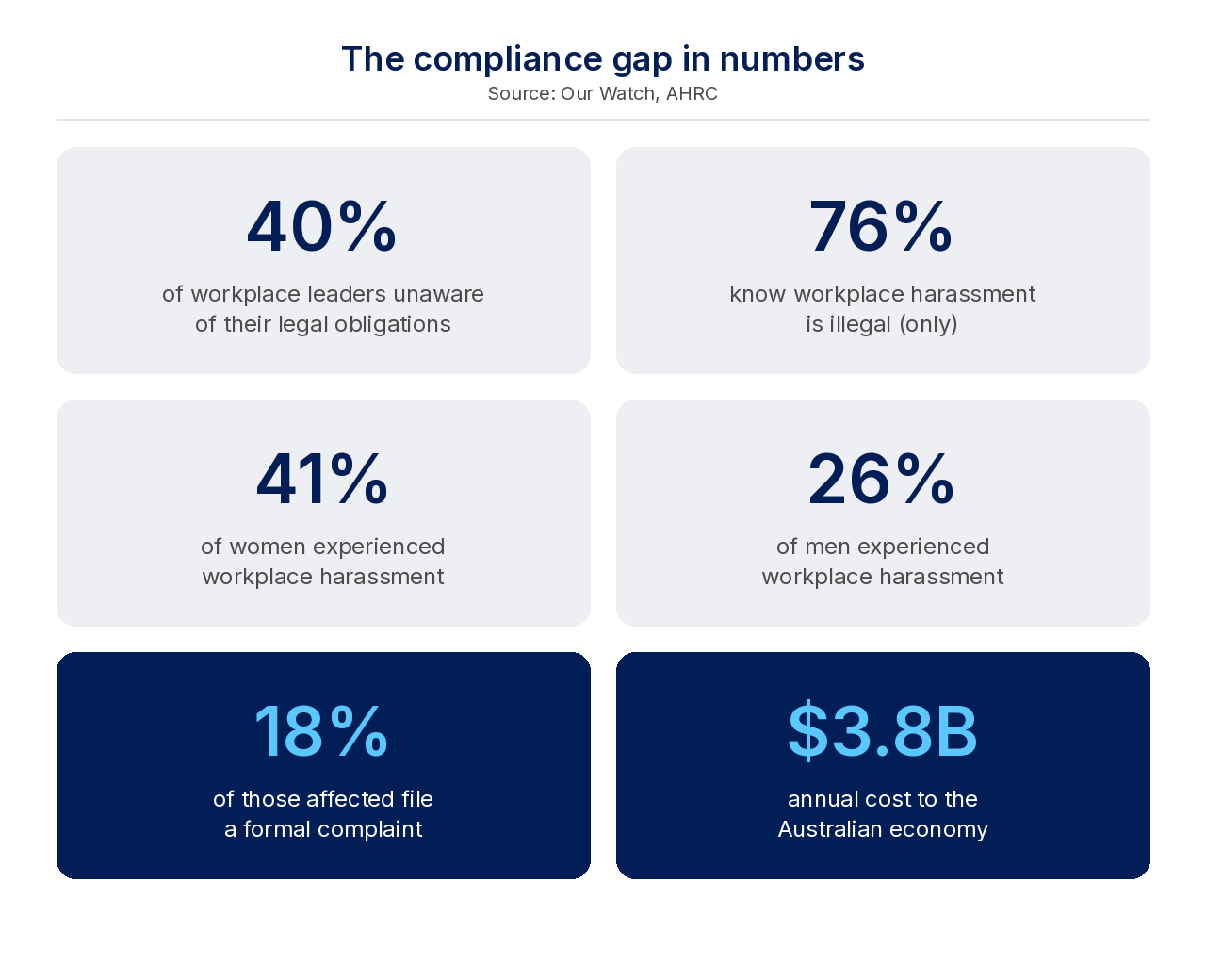
According to Our Watch, 40% of workplace leaders aren’t aware of their legal obligations to prevent sexual harassment, and only 76% know that it’s illegal. Meanwhile, 41% of women and 26% of men report experiencing workplace harassment in the five years leading to 2022. This gap costs the Australian economy an estimated $3.8 billion annually and yet only 18% of those affected file formal complaints.
The Shift to Proactive Prevention
Since December 2022, the Sex Discrimination Act 1984 (Cth) has required all Australian businesses – regardless of size - to take “reasonable and proportionate” measures to eliminate sexual harassment before it occurs. This “positive duty” shifts the focus from investigating complaints to proactively identifying and controlling risks.
For Australian employers, the grace period is over. 2024-25 marked the first full year of active compliance monitoring, with the AHRC conducting four formal inquiries and 35 employer engagements involving 7,500 workers across sectors like hospitality, retail and healthcare.
The Seven Standards for Compliance
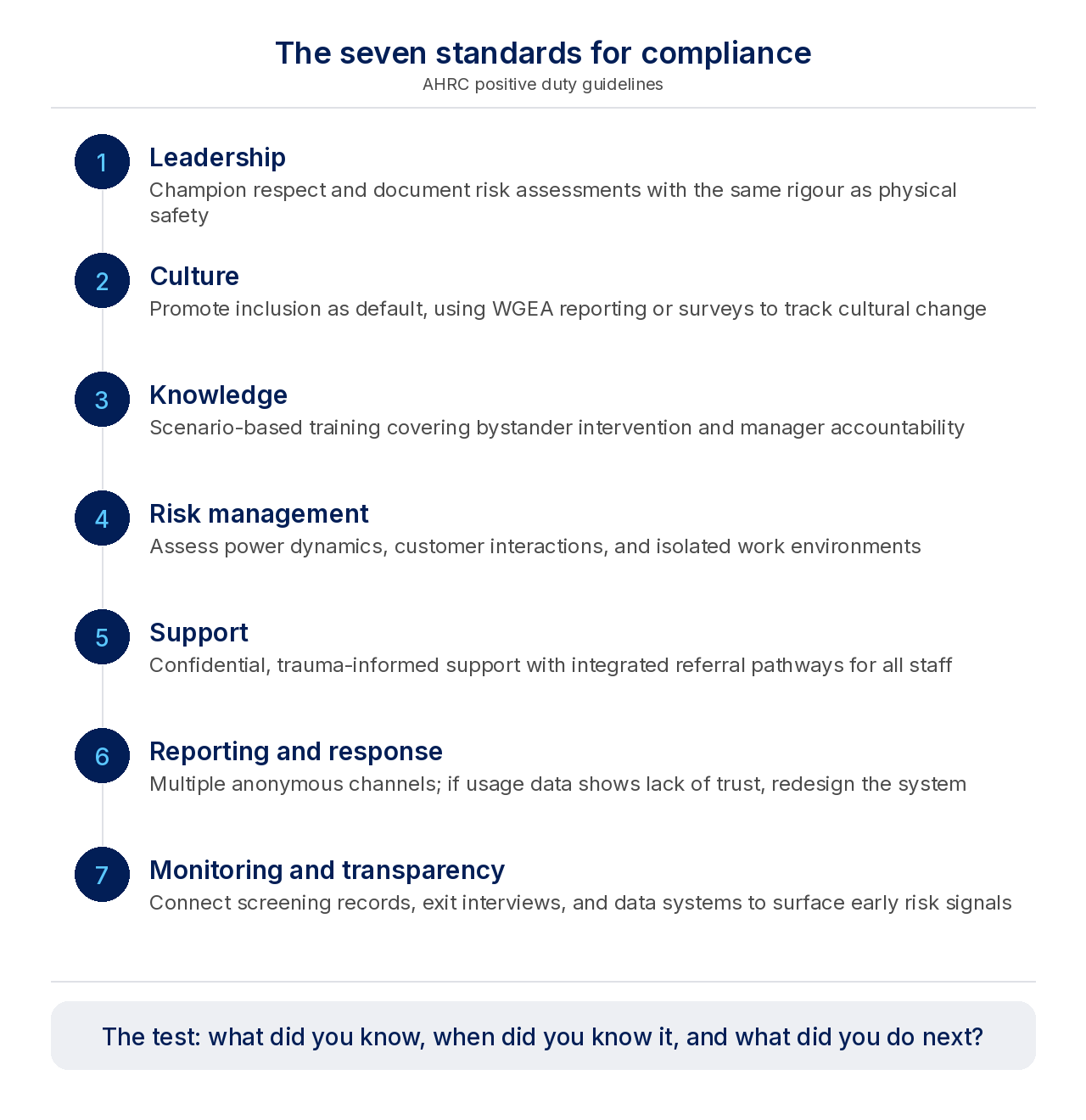
The AHRC Guidelines set a national benchmark through seven key standards:
The WHS Convergence
Australian employers now face dual compliance pressure. As of March 2025, the Work Health and Safety Code of Practice classifies sexual and gender-based harassment as a “psychosocial hazard”. Similarly, Victoria’s 2025 regulations require psychological health risks to be managed with the same rigour as physical hazards – essentially treating a toxic culture with the same legal weight as a faulty forklift.
While the AHRC looks for safe, anonymous reporting, WHS regulators expect incident registers and hazard controls. An integrated platform that captures reports, documents responses and tracks patterns serves both requirements simultaneously.
Building Prevention Architecture
The regulatory environment is tightening. The AHRC has called for civil penalties for positive duty breaches and stricter limits on NDAs in harassment cases. Nationally, the states are leading the charge:
- Queensland now explicitly requires a written "prevention plan" if psychosocial risks are identified.
- NSW became the first Australian jurisdiction to empower a state-based tribunal to award monetary damages (up to $100,000) specifically for workplace bullying and sexual harassment.
- Victoria passed legislation to restrict the use of NDAs to prevent the silencing of workplace victims.
Navigating positive duty means finding an approach that fits your specific business size and industry. While requirements scale with your resources, the need for evidence is universal. The goal isn't perfection on day one but demonstrating a systematic approach to prevention. By keeping detailed records of policies, training, and consultations, businesses are building a roadmap for continuous improvement.
Veremark's workplace trust platform helps Australian organisations meet AHRC positive duty and WHS Code requirements through connected screening, monitoring and speak-up systems. Talk to us about building prevention architecture that demonstrates compliance.


.png)
FAQs

This depends on the industry and type of role you are recruiting for. To determine whether you need reference checks, identity checks, bankruptcy checks, civil background checks, credit checks for employment or any of the other background checks we offer, chat to our team of dedicated account managers.
Many industries have compliance-related employment check requirements. And even if your industry doesn’t, remember that your staff have access to assets and data that must be protected. When you employ a new staff member you need to be certain that they have the best interests of your business at heart. Carrying out comprehensive background checking helps mitigate risk and ensures a safer hiring decision.
Again, this depends on the type of checks you need. Simple identity checks can be carried out in as little as a few hours but a worldwide criminal background check for instance might take several weeks. A simple pre-employment check package takes around a week. Our account managers are specialists and can provide detailed information into which checks you need and how long they will take.
All Veremark checks are carried out online and digitally. This eliminates the need to collect, store and manage paper documents and information making the process faster, more efficient and ensures complete safety of candidate data and documents.
In a competitive marketplace, making the right hiring decisions is key to the success of your company. Employment background checks enables you to understand more about your candidates before making crucial decisions which can have either beneficial or catastrophic effects on your business.
Background checks not only provide useful insights into a candidate’s work history, skills and education, but they can also offer richer detail into someone’s personality and character traits. This gives you a huge advantage when considering who to hire. Background checking also ensures that candidates are legally allowed to carry out certain roles, failed criminal and credit checks could prevent them from working with vulnerable people or in a financial function.
Trusted by the world's best workplaces


APPROVED BY INDUSTRY EXPERTS
.png)
.png)


and Loved by reviewers


Transform your hiring process
Request a discovery session with one of our background screening experts today.