
A complete guide to Global Sanctions Checks: 2026 updates


Sanctions screening is now a core hiring control for roles with financial, operational, security or reputational risk. HR and compliance teams can no longer treat it as a financial services problem alone.
A candidate may have the right qualifications, clean references and a strong interview record, yet still create legal exposure if they are subject to sanctions, linked to a sanctioned entity, or restricted from working in certain regulated roles. For international employers, the risk is sharper. Hiring across borders means dealing with different sanctions regimes, different data sources and faster list changes.
In 2026, global sanctions checks matter because sanctions lists are changing quickly, regulators expect better evidence of screening decisions, and employment screening is under closer scrutiny.
What is a global sanctions check?
A sanctions check screens a candidate against official lists of individuals, organisations, vessels and entities subject to restrictions. These restrictions may include asset freezes, travel bans, investment bans, trade controls or limits on making funds and economic resources available.
For employers, the aim is simple: confirm whether hiring, paying, placing or giving systems access to a candidate would create a sanctions risk.
This is most relevant for roles involving finance, payments, procurement, logistics, legal services, export-controlled goods, sensitive data, government work, crypto, defence, energy, insurance and senior leadership. It can also apply to contractors, consultants, directors and existing employees who move into higher-risk roles.
A sanctions check should sit alongside wider pre-employment screening, such as identity checks, criminal record checks, employment history checks and right to work checks. Used in isolation, it gives a narrow view. Used as part of a risk-based screening package, it helps HR and compliance teams make cleaner hiring decisions.

What changed in 2026?
The main 2026 update for UK employers is the move to a single UK sanctions source. The OFSI Consolidated List of Asset Freeze Targets closed on 28 January 2026. The UK Sanctions List is now the only source for all current UK sanctions designations. Employers and screening providers should make sure their policies, systems and audit trails reflect that change. (GOV.UK)
The UK has also been reviewing how ownership and control rules work in practice. OFSI’s 2026 call for evidence focused on the difficulty of assessing whether a designated person controls an entity through structures, trusts or proxies. This matters for employers because sanctions risk can sit behind a person’s business interests or affiliations, rather than their name alone. (GOV.UK)
Sanctions activity also remains high. In June 2026, the UK announced new Russia-related measures covering financial institutions, military logistics networks and more than 20 oil and gas vessels. The EU also added individuals and entities connected to Russia’s military-industrial base, shadow fleet activity and political interference. (Reuters)
For employers, the lesson is practical. A check run last month may no longer reflect today’s risk. Sanctions screening needs fresh data, clear match handling and the ability to repeat checks when risk changes.
Which lists should employers screen against?
There is no single global sanctions list. Screening usually draws from several sources, depending on the employer’s locations, candidate footprint, customer base and regulatory exposure.
Key sources include the UK Sanctions List, the US OFAC Specially Designated Nationals list and consolidated non-SDN lists, the EU consolidated list and UN Security Council sanctions list. OFAC provides downloadable sanctions list data and a search tool that uses fuzzy matching to find potential name matches. The UN list includes identifying information such as dates of birth, addresses, national identification numbers and listing dates. (OFAC)
For HR teams, the important point is scope. A UK-only check may be insufficient for a candidate who has lived in Singapore, worked for a US-regulated bank and will handle payments for EU clients. Screening should reflect the role, the employer’s legal exposure and the candidate’s international history.
Veremark supports employment screening across 180 countries, which helps employers build screening workflows around actual hiring risk rather than a one-size-fits-all process. See Veremark’s background checks platform for more detail.
When should sanctions checks happen?
The usual point is pre-employment, after candidate consent and before the role starts. This gives the employer time to assess any possible match before access, payroll or customer exposure begins.
That said, pre-employment screening is not always enough. Existing employees may change roles, gain access to regulated systems, move country, take on a directorship or become involved in higher-risk work. Veremark has written about why background checking existing employees can be necessary at recognised points in the employment lifecycle.
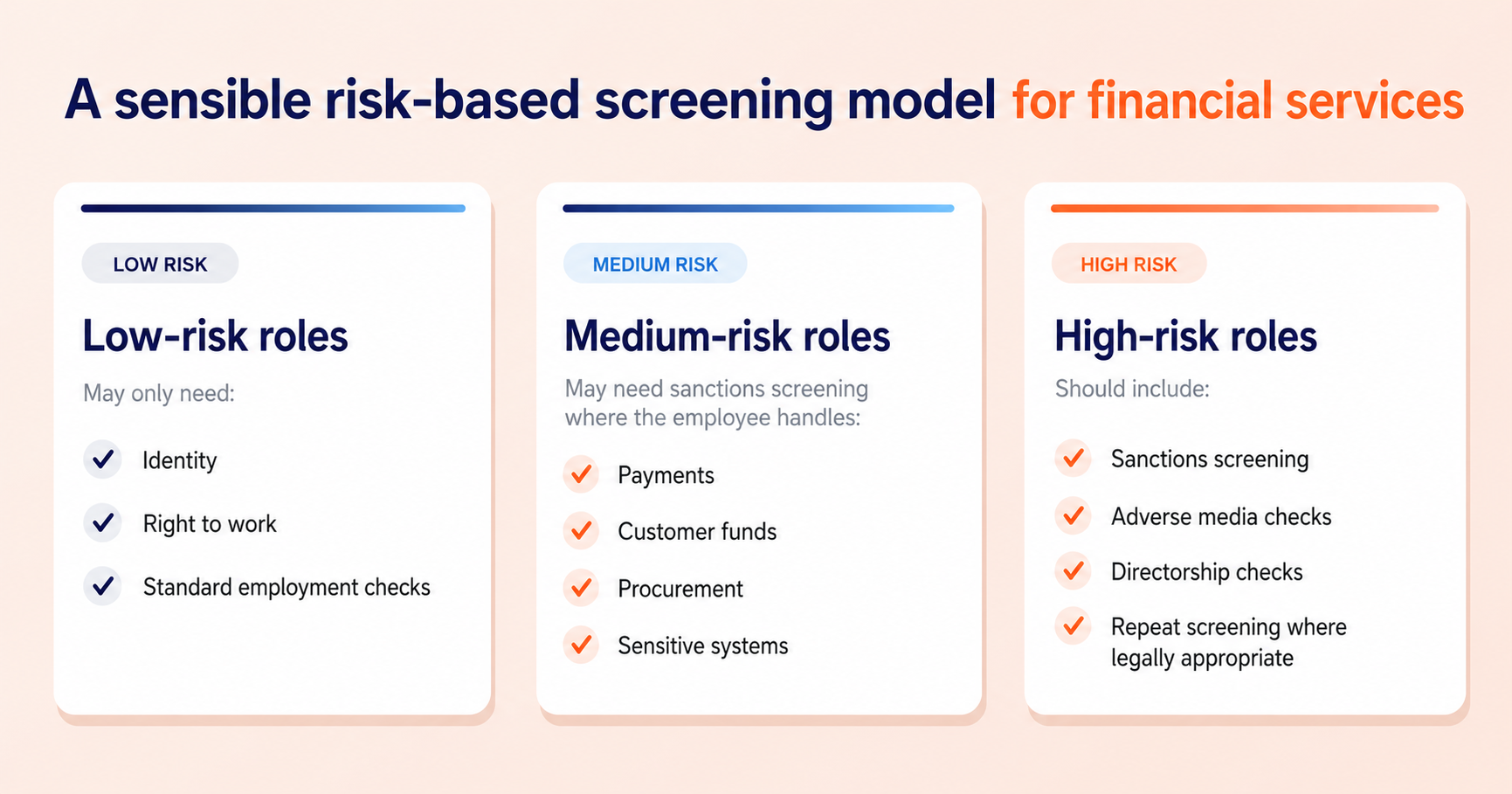
A sensible model is risk-based:
Low-risk roles may only need identity, right to work and standard employment checks.
Medium-risk roles may need sanctions screening where the employee handles payments, customer funds, procurement or sensitive systems.
High-risk roles should include sanctions screening, adverse media checks, directorship checks and repeat screening where legally appropriate.
This keeps screening proportionate and easier to defend.
How to handle a potential match
A possible sanctions match should never trigger an automatic rejection without review. Name matching can produce false positives, especially where names are common, transliterated, shortened or recorded differently across jurisdictions.
A good review process checks identifiers such as date of birth, nationality, address history, passport details, known aliases and associated entities. It should also record who reviewed the match, what evidence was used and why the decision was made.
Automation helps with speed and consistency, but human review is critical for edge cases. Veremark’s article on AI for background checks and compliance risk makes the same point: technology can support screening, while people should review complex cases and exceptions.
The process should also respect employment law, privacy rules and candidate rights. Candidates should know what checks are being carried out, why they are relevant and how their data will be handled.
What HR and compliance leaders should update now
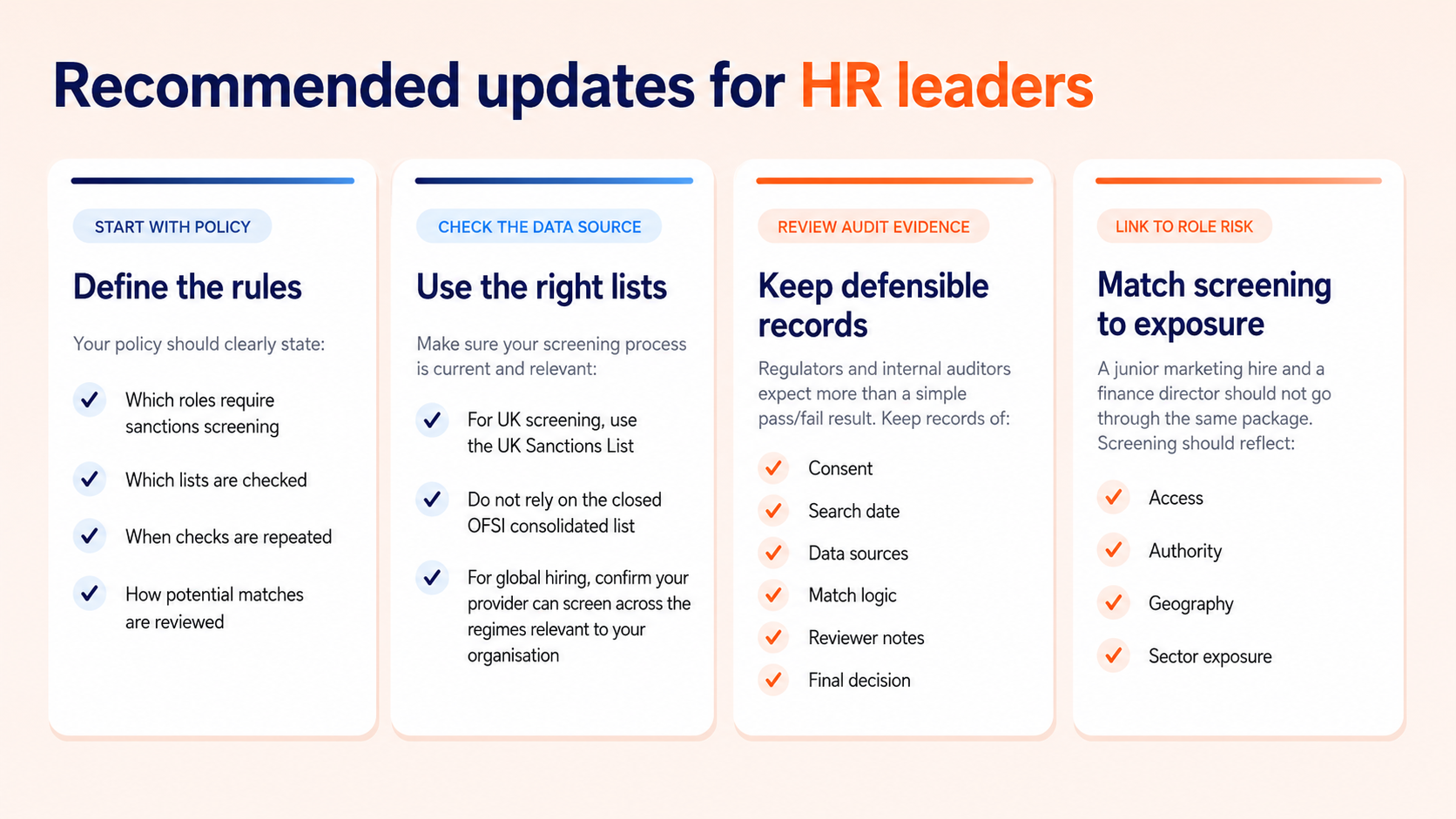
Start with policy. It should state which roles require sanctions screening, which lists are checked, when checks are repeated and how potential matches are reviewed.
Then check the data source. For UK screening, make sure your process uses the UK Sanctions List rather than the closed OFSI consolidated list. For global hiring, confirm that your provider can screen across the regimes relevant to your organisation.
Next, review audit evidence. Regulators and internal auditors will expect more than a pass or fail result. Keep records of consent, search date, data sources, match logic, reviewer notes and final decision.
Finally, link sanctions screening to role risk. A junior marketing hire and a finance director should not go through the same screening package. Screening should reflect access, authority, geography and sector exposure.
Next steps to stay compliant
Sanctions screening has become a practical hiring control for any employer exposed to financial crime, regulated work, international hiring or reputational risk. A strong process checks whether a candidate appears on international government databases, enforcement lists or watchlists that may restrict them from working in certain roles or sectors.
Veremark’s Global Sanctions Check searches more than 1,800 international enforcement databases and global watchlists across over 190 countries, with data updated every 24 hours. The check usually requires the candidate’s full name, date of birth and current address, and results are typically processed within seven days.
For HR and compliance leaders, the value is wider than a pass or fail result. Global sanctions checks can support AML, OFAC, Patriot Act and wider international compliance duties, while also helping identify politically exposed persons, close family members and associates where relevant. They add another layer of verification against UK and global address and contact data, helping employers reduce fraud risk and meet due diligence obligations.
The best approach in 2026 is risk-based, documented and repeatable. Employers should screen candidates before they start, review potential matches carefully, and connect sanctions screening with wider background checks such as identity, right to work, criminal record and civil background checks. Digital records can also help maintain an up-to-date staff database and reduce unnecessary repeat checks when information remains valid.

Read More


.png)
.png)
.webp)

FAQs

This depends on the industry and type of role you are recruiting for. To determine whether you need reference checks, identity checks, bankruptcy checks, civil background checks, credit checks for employment or any of the other background checks we offer, chat to our team of dedicated account managers.
Many industries have compliance-related employment check requirements. And even if your industry doesn’t, remember that your staff have access to assets and data that must be protected. When you employ a new staff member you need to be certain that they have the best interests of your business at heart. Carrying out comprehensive background checking helps mitigate risk and ensures a safer hiring decision.
Again, this depends on the type of checks you need. Simple identity checks can be carried out in as little as a few hours but a worldwide criminal background check for instance might take several weeks. A simple pre-employment check package takes around a week. Our account managers are specialists and can provide detailed information into which checks you need and how long they will take.
All Veremark checks are carried out online and digitally. This eliminates the need to collect, store and manage paper documents and information making the process faster, more efficient and ensures complete safety of candidate data and documents.
In a competitive marketplace, making the right hiring decisions is key to the success of your company. Employment background checks enables you to understand more about your candidates before making crucial decisions which can have either beneficial or catastrophic effects on your business.
Background checks not only provide useful insights into a candidate’s work history, skills and education, but they can also offer richer detail into someone’s personality and character traits. This gives you a huge advantage when considering who to hire. Background checking also ensures that candidates are legally allowed to carry out certain roles, failed criminal and credit checks could prevent them from working with vulnerable people or in a financial function.
Trusted by the world's best workplaces


APPROVED BY INDUSTRY EXPERTS
.png)
.png)


and Loved by reviewers


Transform your hiring process
Request a discovery session with one of our background screening experts today.



.webp)