
How do anonymous whistleblowing channels work? A deep dive into the technology, security, and legal considerations


When something is seriously wrong inside your organisation, your people often know before leadership does. The question is - do they feel safe enough to report it?
A balanced reporting framework and a secure independent whistleblowing channel, built by a third party, gives your employees, contractors and other stakeholders a confidential route to raise concerns outside normal management lines.
Instead of reporting through a manager, HR inbox or internal form, they can use an independent channel designed to protect their identity, capture the right information and support proper follow-up.
This is about more than giving people another way to speak up. It helps you reduce blind spots to misconduct, fraud, harassment, safety concerns and regulatory breaches,
A well-run external channel helps you surface issues earlier, maintain a clearer audit trail and show that you take reporting seriously. It also builds trust.
Your people may hesitate to report something if the concern involves their manager, a senior leader or a team they depend on. A third party route can remove some of that pressure by making the process feel more independent and less exposed, with the option for complete anonymity.
"Anonymity only works if it's real. The moment a reporter suspects a report could be traced back to them, you've lost the channel's entire value.” - David Morgan, Veremark’s Director of Whistleblowing
As you review your risk and compliance controls, a third party whistleblowing channel is worth serious consideration. The question is not whether concerns will arise. They will. The question is whether people have a safe, credible way to raise them before they become larger problems.
What an anonymous whistleblowing channel actually does
An anonymous reporting system separates the reporter’s identity from the substance of the concern. The person raising the issue can submit information without giving their name, work email address or other identifying details.
In practice, this means a secure online form, a structured case record and a way for investigators to ask follow-up questions without revealing who the reporter is. This matters because many reports need clarification. A one-way inbox can leave compliance teams with a serious allegation and too little evidence to act.
Veremark’s whistleblowing platform is built for this problem. It gives organisations a secure speak-up route for whistleblowing and workplace complaints, supported by case management so reports can be received, assessed and tracked in one place.
The benefits of a third-party channel
Anonymous reporting
A good whistleblowing channel has three core technical jobs.
First, it must collect information in a consistent way. Free-text email complaints are hard to triage. Structured reporting helps compliance teams capture the issue type, overview of the allegation and lines of enquiry, subjects, witnesses and complaint details, dates, locations, evidence and urgency.
Second, it must protect the reporter’s identity. That means avoiding unnecessary personal data collection, controlling metadata, and limiting access to case details. An anonymous channel should not quietly recreate identity through careless settings, broad admin rights or exported files.
Third, it must support two-way communication. Anonymous does not have to mean unreachable. Secure messaging lets the investigator ask for documents, timelines or clarification questions while the reporter remains unnamed.
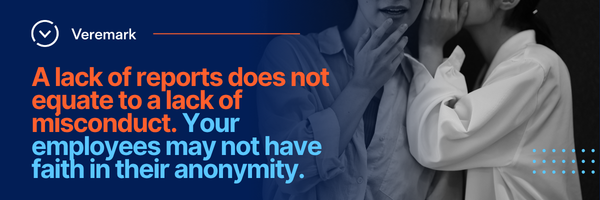
This is where an encrypted third-party channel is often stronger than a generic internal mailbox. Encryption means scrambling report data into unreadable code so it can only be accessed by the sender and the designated investigators. No hackers, internal IT staff, or even the software provider can intercept the message.
Veremark’s article on in-house versus outsourced whistleblowing hotlines makes the core point clearly: anonymity, encryption and two-way communication are central to building confidence in the reporting process.
No internal IT support is required
A third party whistleblowing channel should be quick to set up without adding pressure to your internal IT team. The technology is hosted and managed by the provider, so there is no software to install, no internal infrastructure to maintain and no need to build a reporting tool from scratch.
That matters because compliance teams often need to move quickly. A hosted platform lets you create a secure reporting route, configure access for the right people and launch the channel without waiting for a long technical project.
Flexible by design
Every organisation handles reports differently. A good whistleblowing channel lets you shape the process around your policy, risk structure and investigation model.
Custom workflows can route different types of reports to the right teams, set review stages, assign case owners and support escalation where needed. This helps your team move from intake to triage to investigation in a controlled way, rather than relying on ad hoc emails or manual handovers.
Accountability built into the process
Whistleblowing cases need clear ownership. The technology should show who is responsible for each case, what actions have been taken and what still needs to happen.
Built-in accountability means case activity is recorded, deadlines can be tracked and decisions are easier to evidence later. For compliance teams, this creates a stronger audit trail and reduces the risk that serious concerns are missed, delayed or handled informally.
Security controls from a whistleblowing channel
Security is not a feature label. It has to show up in how the system is configured and governed.
Access should be restricted to named users with a clear role in triage, investigation or oversight. Case files should have audit trails so the organisation can see who accessed a report, when they accessed it and what action they took.
Data should be encrypted in transit and at rest. Retention rules should be set before the first report arrives. A whistleblowing case can include sensitive personal data, allegations about named individuals and information that may later be used in disciplinary, regulatory or legal proceedings.
Confidentiality also has to survive routine processes. The UK Information Commissioner’s Office has said organisations should withhold information that identifies a whistleblower unless the whistleblower consents or disclosure is reasonable without consent. (ICO)
Legal considerations for compliance teams
The legal position depends on the countries where you operate, the sector and the nature of the concern. The EU Whistleblower Protection Directive sets expectations around internal and external reporting channels, while UK rules protect workers who make qualifying protected disclosures. (Eur-Lex). In some industries, a clear whistleblowing process and channel is a legal requirement.
Compliance teams should focus on practical questions:
Who can report? What can they report? Who receives the case? How quickly is it acknowledged? Who investigates? How is the reporter protected from retaliation? How long is the case retained? What happens when the allegation concerns someone senior?
These questions should be answered in the policy and reflected in the system workflow. Veremark’s guide on why a practical whistleblower policy is essential is a useful companion piece because technology will fail if employees do not understand the process.
Veremark's Director of Whistleblowing Technology, David Morgan, spoke to HRD Australia in more detail about the lessons organisations can learn about effective and compliant whistleblowing processes. Read the full article here.
Why promotion matters
A channel that nobody uses is not a control. It is a page on the intranet.
Employees need to know what the route is for, when to use it and what will happen after they submit a report. Managers need to know how to respond if someone raises a concern directly. Senior leaders need to show that reporting is treated seriously rather than seen as disloyal.
Veremark’s article on promoting your whistleblowing programme makes this point through a practical example: the channel was widely advertised across the workforce and leaders openly discussed its use.
Where Veremark fits
Veremark’s whistleblowing channel is designed for organisations that need a secure, independent route for employees and other stakeholders to raise concerns. For compliance teams, the value is not only the reporting form. It is the combination of anonymity, secure case handling, structured intake and a clearer process for follow-up.
That matters at the top and middle of the funnel because many organisations already know they need a speak-up route. The harder question is whether their current process would stand up under pressure. Shared inboxes, manager escalation chains and informal reporting lines often look acceptable until the concern involves fraud, harassment, safety, corruption or senior leadership.
The right whistleblowing channel gives compliance teams earlier visibility of risk and gives employees a safer way to speak. That is the standard to judge the technology against.
International workforce organisation, PeopleIN, already had a whistleblowing hotline in place with one of the Big 4, but found the solution too expensive, not customisable to business needs, and simply wasn’t of any value. That’s where Veremark stepped in.
“What we loved about the Veremark solution was the adaptability of the solution and its contemporary approach, with a primary focus on security and protection of the whistleblower. This anonymous encrypted channel now compliments our other complaints management processes.” -Tom Reardon, Founder and Director of PeopleIN
.png)
Read More


.png)
.png)


FAQs

In some jurisdictions and for certain organisations, whistleblowing channels are legally required; requirements depend on company size, location, and applicable regulations.
Implementation can be quick for standard software setups, but more complex rollouts with custom workflows, languages, training, and policies may take longer. Veremark can launch an online hotline for your organisation very quickly - but we also offer full consultation prior to roll-out, as well as a white-labeled product for organisations who need this option.
Anonymity is available should the employee wish to withhold their identity. Built with security and experience in mind, our solution is hosted on an end-to-end encrypted platform.
Trusted by the world's best workplaces


APPROVED BY INDUSTRY EXPERTS
.png)
.png)


and Loved by reviewers


Transform your hiring process
Request a discovery session with one of our background screening experts today.



.png)