
AI is changing hiring faster than most organisations realise


Verification in the age of synthetic credentials
For years, organisations have relied on a familiar set of hiring signals. A degree from a recognised institution. A coherent CV. A confident interview. A reference that sounds credible. A professional online presence that appears consistent with the person in front of you.
Those signals still matter, but they are becoming harder to interpret with confidence.
This is partly because AI can generate content quickly, but the bigger shift is that AI is now influencing both sides of the hiring process at once. Employers are adopting AI across more workflows, while talent markets are adapting in response. The World Economic Forum’s Future of Jobs Report 2025 found that about half of employers plan to reorient their business in response to AI, while two-thirds expect to hire talent with specific AI skills. AI is no longer a niche topic in recruitment. It is becoming part of the wider labour market context in which hiring decisions are made.
That matters because hiring has always depended on interpretation. Employers do not only assess facts. They read signals and infer judgement, capability, and credibility from how a candidate presents themselves. When AI makes it easier to polish, generate, or simulate those signals, the question becomes less about whether a profile looks strong and more about whether the underlying signals still carry the same meaning. This is why the issue is better understood as a trust challenge within hiring, rather than simply a fraud problem.
The real change is signal inflation
One of the most significant effects of AI in hiring is not limited to fully fabricated candidates, although that risk is clearly part of the picture. A broader issue is that AI can raise the quality of surface-level signals across the board.
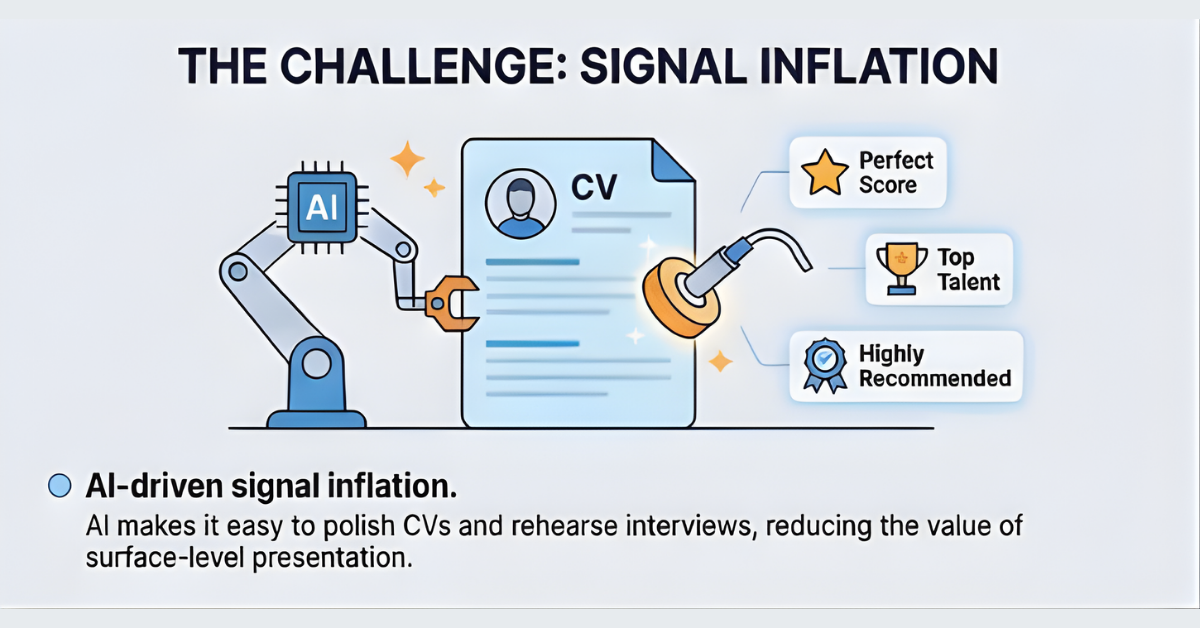
Candidates can now use AI to refine CVs, tailor cover letters, generate portfolio summaries, rehearse answers, and strengthen professional profiles in minutes. Employers, meanwhile, are also using AI to screen, sort, and evaluate applicants at greater scale. Microsoft’s Work Trend Index describes AI as a major force reshaping work globally, based on survey data from 31,000 people across 31 countries and large-scale productivity signals. That wider change matters because hiring signals are shaped by the way people work, communicate, and present themselves every day.
The challenge is not that polished communication has suddenly become illegitimate. It is that presentation is now easier to optimise than ever before. As a result, surface fluency carries less value as a differentiator on its own. Hiring teams therefore need stronger ways to distinguish between a candidate who communicates well, a candidate who thinks well, and a candidate whose profile has been substantially assembled by tools.
Verification now has a different job to do
This is where the conversation moves beyond recruitment efficiency and into verification.
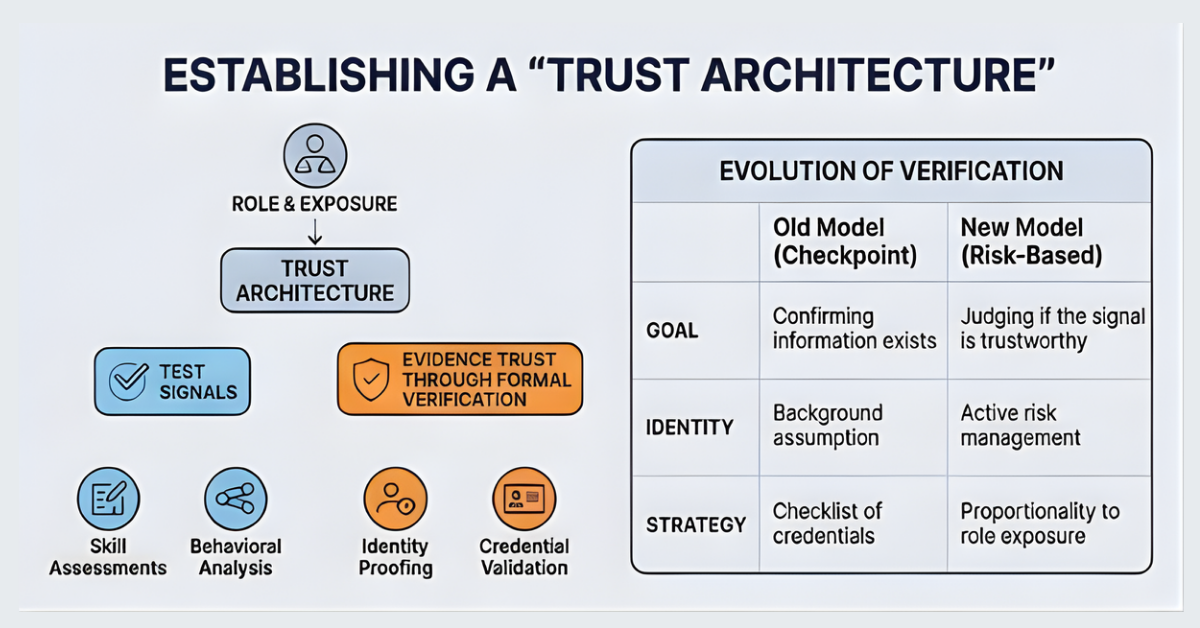
In an earlier era, verification was often treated as a checkpoint. Confirm the person’s identity. Confirm the credential. Confirm the employment history. But in an AI-shaped environment, verification needs to do more than establish whether information exists. It increasingly needs to help organisations judge whether the signal behind that information is trustworthy.
NIST’s Digital Identity Guidelines are useful here because they frame digital identity as a risk management issue, not just a technical one. The guidance explains that identity proofing, authentication, and related controls should be selected according to risk and context. It also distinguishes between different assurance levels and proofing approaches, including remote identity verification. That logic is especially relevant when hiring is conducted digitally and identity is being established before access, authority, or system permissions are granted.
Put simply, verification is no longer only about checking boxes. Organisations increasingly need it to help determine which parts of the hiring process require stronger assurance because the downstream consequences of getting it wrong are greater.
Remote hiring has made identity a more active question
The move to remote and distributed hiring has made identity less implicit than it used to be.
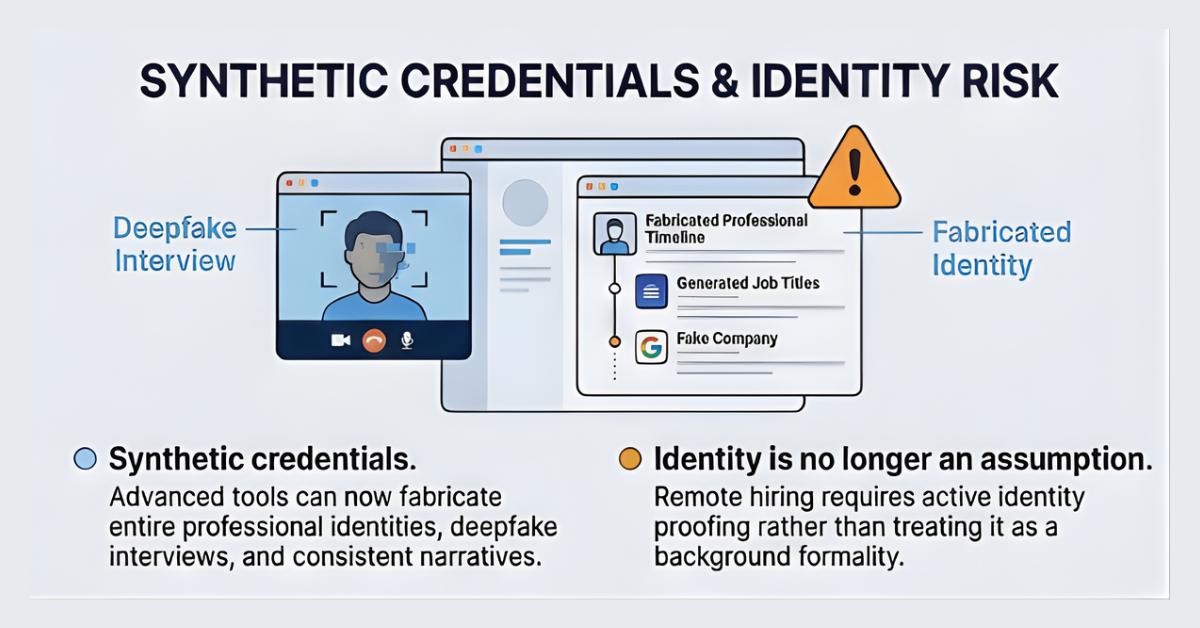
NIST’s identity guidance notes that remote proofing can be achieved through different models, but also that stronger assurance requires additional evidence, validation, and verification steps to reduce impersonation and proofing errors. That matters because digital hiring environments create different conditions from in-person ones. The organisation may never meet the candidate physically before onboarding. Documents are shared electronically. Interview conditions are harder to control. The process may be convenient, but it is no longer safe to treat identity as a background assumption.
That pressure is increasing as synthetic media improves. Deloitte has described deepfakes as a cybersecurity-scale challenge, and more recent Deloitte analysis has pointed to a world in which AI can fabricate entire candidates, including deepfaked interviews and synthetic identities. These developments do not mean every remote hire should be viewed with suspicion. They do show that identity now needs more deliberate attention in digital hiring processes.
The World Economic Forum has made a similar point from a different angle. Its 2025 coverage of AI-driven fraud argued that digital identity wallets, biometrics, and liveness detection are becoming more important because AI is increasing both the scale and sophistication of impersonation. That point extends beyond payments or consumer platforms. It signals a broader shift in how organisations establish confidence online.
The old hiring model was built for a different kind of misrepresentation
Most hiring processes were designed around a familiar type of embellishment. Inflated achievements. Smoothed-over gaps. A more flattering reference than reality justified.
AI changes both the scale and the coherence of that dynamic. It makes it easier to construct a consistent narrative across application answers, portfolios, emails, online profiles, and interview preparation. The issue is rarely confined to one false statement. More often, the concern is that the overall picture creates a level of confidence that the underlying reality may not fully support.
That is why the deeper challenge is not simply spotting a red flag. It is reassessing which signals still deserve weight. As the World Economic Forum’s labour market reporting shows, AI is changing the skills employers value and the structure of work itself. Hiring processes built around older assumptions about authenticity, effort, and presentation will increasingly struggle to keep pace.
Better signals matter more than more signals
One possible response is to add more process, more interviews, and more assessments.
That may not always be the best answer.
A more useful response is often to improve the quality of trust signals rather than simply increase the quantity of them. In practice, that means asking harder questions. Which parts of our hiring process are easiest to manipulate with AI? Where are we relying too heavily on polished presentation? Which roles need stronger identity assurance because the downstream exposure is higher? How should we distinguish between acceptable AI assistance and unacceptable AI misrepresentation?

NIST’s risk-based approach is helpful because it pushes organisations away from blanket controls and towards proportionality. The goal is not to treat every role in the same way. It is to align the level of assurance with the real-world consequences of the hiring decision being made.
This is a leadership issue, not only a hiring issue
The organisations that respond well to this shift are unlikely to be the ones that simply ban AI from the hiring process. In many cases, that would be unrealistic, difficult to enforce, or disconnected from how work is now done. Microsoft’s research and the World Economic Forum’s workforce reporting both point to the same underlying truth: AI is becoming embedded in work, skill development, and decision-making at a structural level.
They are more likely to be the ones that become clearer about where trust should be established, how it should be evidenced, and which signals are too important to leave untested.
In an environment shaped by synthetic credentials and AI-assisted presentation, the more useful question for leaders is whether their trust model is evolving quickly enough to keep pace with the hiring reality around them.
Continue the conversation
This article is part of Veremark’s broader series on workforce trust. For the full perspective, including the six-stage trust architecture, industry patterns, and key questions for leaders, download the white paper, The Evolution of Workforce Trust and Continuous Accountability.
{{the-workforce-integrity-playbook="/components"}}
Read More
.jpg)


.jpg)
FAQs

This depends on the industry and type of role you are recruiting for. To determine whether you need reference checks, identity checks, bankruptcy checks, civil background checks, credit checks for employment or any of the other background checks we offer, chat to our team of dedicated account managers.
Many industries have compliance-related employment check requirements. And even if your industry doesn’t, remember that your staff have access to assets and data that must be protected. When you employ a new staff member you need to be certain that they have the best interests of your business at heart. Carrying out comprehensive background checking helps mitigate risk and ensures a safer hiring decision.
Again, this depends on the type of checks you need. Simple identity checks can be carried out in as little as a few hours but a worldwide criminal background check for instance might take several weeks. A simple pre-employment check package takes around a week. Our account managers are specialists and can provide detailed information into which checks you need and how long they will take.
All Veremark checks are carried out online and digitally. This eliminates the need to collect, store and manage paper documents and information making the process faster, more efficient and ensures complete safety of candidate data and documents.
In a competitive marketplace, making the right hiring decisions is key to the success of your company. Employment background checks enables you to understand more about your candidates before making crucial decisions which can have either beneficial or catastrophic effects on your business.
Background checks not only provide useful insights into a candidate’s work history, skills and education, but they can also offer richer detail into someone’s personality and character traits. This gives you a huge advantage when considering who to hire. Background checking also ensures that candidates are legally allowed to carry out certain roles, failed criminal and credit checks could prevent them from working with vulnerable people or in a financial function.
Trusted by the world's best workplaces



APPROVED BY INDUSTRY EXPERTS
.png)
.png)


and Loved by reviewers


Transform your hiring process
Request a discovery session with one of our background screening experts today.