
The hidden cost of manual background checks in enterprise HR teams


Manual background checks often look cheaper than outsourcing because the cost sits inside existing headcount. No new supplier fee. No new procurement process. No new budget line to defend. For enterprise HR teams, that is exactly why the cost is easy to miss.
The real question is not whether internal teams can run checks. Most can. The question is what the business loses when senior HR, recruitment operations and local hiring teams spend hours chasing documents, checking references, managing regional rules and updating candidates by hand.
For global HR leaders weighing manual background checks vs outsourced screening, the hidden cost usually shows up in three places: slower hiring, weaker candidate conversion and higher risk.
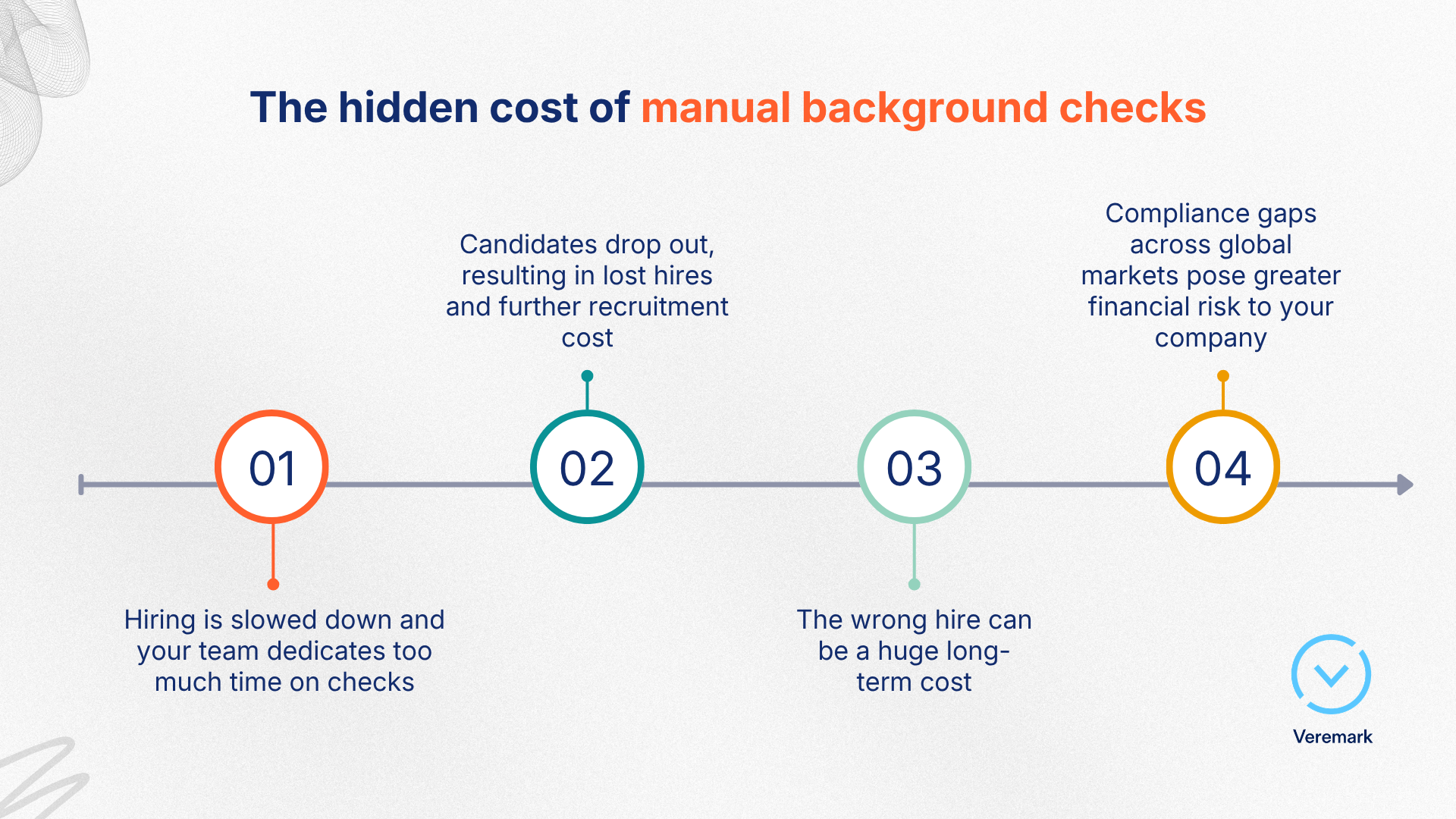
Manual checks slow hiring at the point where speed matters most
Screening sits at a fragile stage of the hiring process. The candidate has accepted an offer, or is close to accepting one, yet they may still be speaking to other employers. Any delay at this point creates risk.
Manual checks slow hiring because they depend on people moving information between systems, countries and inboxes. A recruiter asks for documents. A candidate sends the wrong version. A local HR team checks what is required in that market. A reference does not reply. Someone updates the applicant tracking system. Someone else asks legal or compliance whether the check is enough.
None of this feels dramatic in isolation. A two-day delay here. A missing form there. A local query that waits until Monday. Across hundreds or thousands of hires, it becomes a drag on time to hire.
Enterprise HR teams also face uneven demand. Hiring does not arrive in neat weekly batches. One month may bring a small number of replacements. The next may include a graduate intake, a new market launch, an acquisition or seasonal hiring. Manual processes do not scale cleanly. They stretch the team when demand rises and create inconsistent candidate experiences across regions.
That inconsistency matters. A candidate who receives clear, digital instructions and fast updates is more likely to stay engaged. A candidate who is asked for the same information twice, or hears nothing for a week, starts to doubt the employer.
Slow screening can turn accepted offers into lost hires
The cost of a delayed background check is rarely limited to the screening task itself. When a strong candidate drops out because another employer moves faster, the business pays twice.
First, the hiring team loses the time already invested. That may include recruiter hours, hiring manager interviews, assessments, scheduling, approvals and offer management. Second, the role remains open. Work is delayed, existing employees absorb the gap and the search starts again.
For senior, technical or regulated roles, the cost climbs further. Reopening a search can mean agency fees, extended advertising, more interview time and a longer period before the new hire becomes productive. In global businesses, a delay in one key appointment can slow a whole team or project.
This is where the comparison of manual background checks vs outsourced screening becomes more commercial than operational. A manual process may appear to save supplier cost, yet it can increase the cost per successful hire if it causes candidate drop-off. The loss is often hidden because it sits across different budgets. Recruitment carries the activity. The business unit carries the vacancy. HR operations carries the admin. Finance rarely sees the full chain.
A clearer measure is the cost of getting from accepted offer to cleared, ready-to-start employee. If manual screening adds uncertainty at that stage, it is affecting hiring yield.
The risk of the wrong hire is the largest cost
Speed matters, but speed without control is not the answer. The greater cost comes from poor hiring decisions that could have been avoided with better checks.
A weak screening process can miss gaps in employment history, false qualifications, undisclosed restrictions, role-specific risk factors or issues that vary by country. For many roles, that creates more than a performance problem. It can create compliance, customer, financial, data security or safeguarding risk.
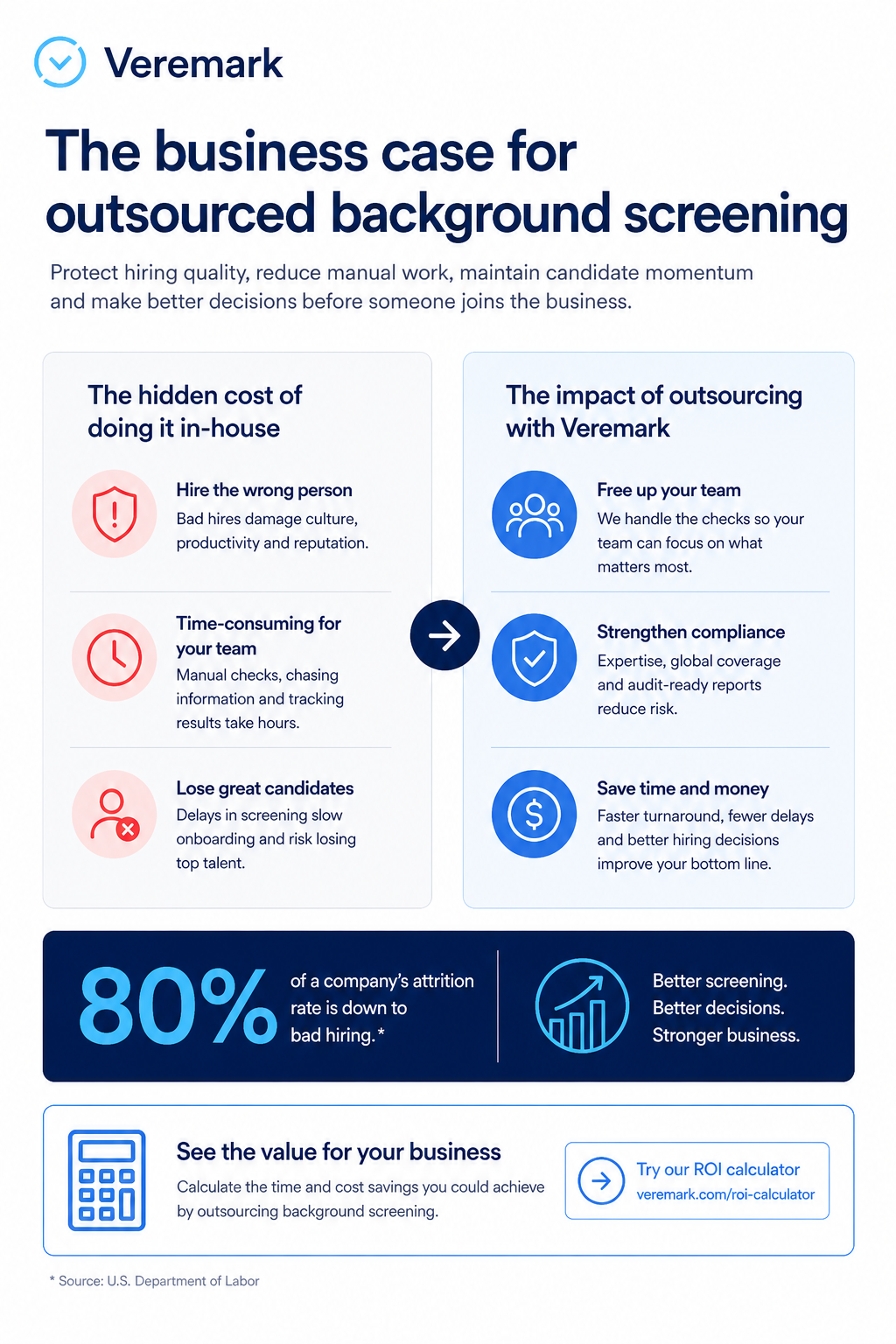
Veremark’s background screening ROI calculator highlights the scale of this issue. It references data showing that 80% of a company’s attrition rate can be linked to bad hiring decisions, and that replacing an employee can cost around 150% of their salary. It also states that Veremark screening can reduce the probability of bad hires by 25% and remove the HR admin burden of in-house pre-hire and employment checks by 100%.
Those figures matter because they move screening out of the admin category. Background checks are a control point in workforce quality. When the wrong person is hired, the cost is not just recruitment replacement. It can include onboarding, training, management time, underperformance, team disruption and, in some roles, direct risk to customers or company assets.
For enterprise HR leaders, this is a board-level argument. Better screening protects hiring decisions at scale.
Manual processes create compliance gaps across markets
Global hiring adds another layer of cost. Each country has its own expectations around identity checks, criminal record checks, employment verification, right to work and data handling. What is acceptable in one market may be inappropriate, incomplete or unlawful in another.
Manual teams often rely on local knowledge, shared folders and old process notes. That can work for a while, especially in familiar markets. It becomes harder when the business grows into new regions, hires remote employees or needs consistency after a merger.
The risk is not always a clear failure. More often, it is uneven practice. One team runs a full employment history check. Another accepts a reference email. One country stores documents securely. Another keeps copies in inboxes. Over time, these variations make it harder to prove that the business is applying fair, consistent and compliant hiring standards.
Veremark’s global background check services and compliance information are useful reference points for HR teams assessing how checks need to adapt across regions.
HR time has a higher-value use
The final hidden cost is opportunity cost. When HR teams run checks manually, they spend time on chasing, filing, updating and reconciling. These tasks are necessary, but they are not where HR creates the most value.
Recruitment teams should be improving hiring quality, reducing drop-off, advising managers and building stronger workforce plans. HR operations should be simplifying processes and improving consistency. Compliance teams should be setting standards, not chasing paperwork.
Outsourcing does not remove accountability from HR. It gives HR better control, clearer reporting and more capacity. A digital screening partner can handle check initiation, candidate communication, document collection, progress updates and evidence capture, while HR keeps oversight of policy, exceptions and outcomes.
For teams comparing manual background checks vs outsourced screening, the decision should start with total cost. That means including delays, lost candidates, re-hiring, bad-hire risk, compliance exposure and internal admin time.
Manual checks may look low-cost because the invoice is missing. The cost is still there. It is spread across slow hiring, weaker candidate conversion and risk that only becomes visible when something goes wrong.
To estimate the financial impact in your own organisation, use Veremark’s background screening ROI calculator.
Read More


.png)

FAQs

Yes, background checks for non-permanent staff are often necessary to ensure a safe and trustworthy work environment, regardless of employment duration. The scope of the checks may vary depending on the nature of the role.
Most employers use a combination of police checks, employment history verifications, and reference checks. Additional checks can include education verification, right to work checks, and identity verification, depending on the job requirements.
Yes, background checks are necessary for seasonal roles to ensure workplace safety and compliance with legal employment standards.
Trusted by the world's best workplaces


APPROVED BY INDUSTRY EXPERTS
.png)
.png)


and Loved by reviewers


Transform your hiring process
Request a discovery session with one of our background screening experts today.