
Prevention is a System, not a Policy: The End of “Hire Once, Trust Forever.”


How many organisations are genuinely monitoring whether sexual harassment is occurring, or just documenting what would happen, should someone report it?
According to the EHRC, regulators no longer ask whether leaders have a policy. They ask, "How do you know your workplace is safe?" The difference between these questions reveals the gap between documentation and prevention. One requires a static file - the other a live integrity system that creates continuous visibility into what's happening across your workforce.
The Structural Obsolescence of "Hire Once, Trust Forever"
Historically, "trust" has operated as a hiring milestone. A candidate is interviewed, background checks are clear and access is granted. From that point forward, trust is largely assumed.
It’s a model that is now structurally obsolete. In a world of distributed teams and shifting workplace dynamics, risk is not static. It evolves as roles change, power dynamics shift and team restructures create new vulnerabilities long after onboarding. To meet the Positive Duty standards now set in Australia and the UK, prevention must move from episodic compliance to persistent accountability. This is best visualised as the Trust Infinity Loop:
The Prevention Lifecycle: Closing the Gaps
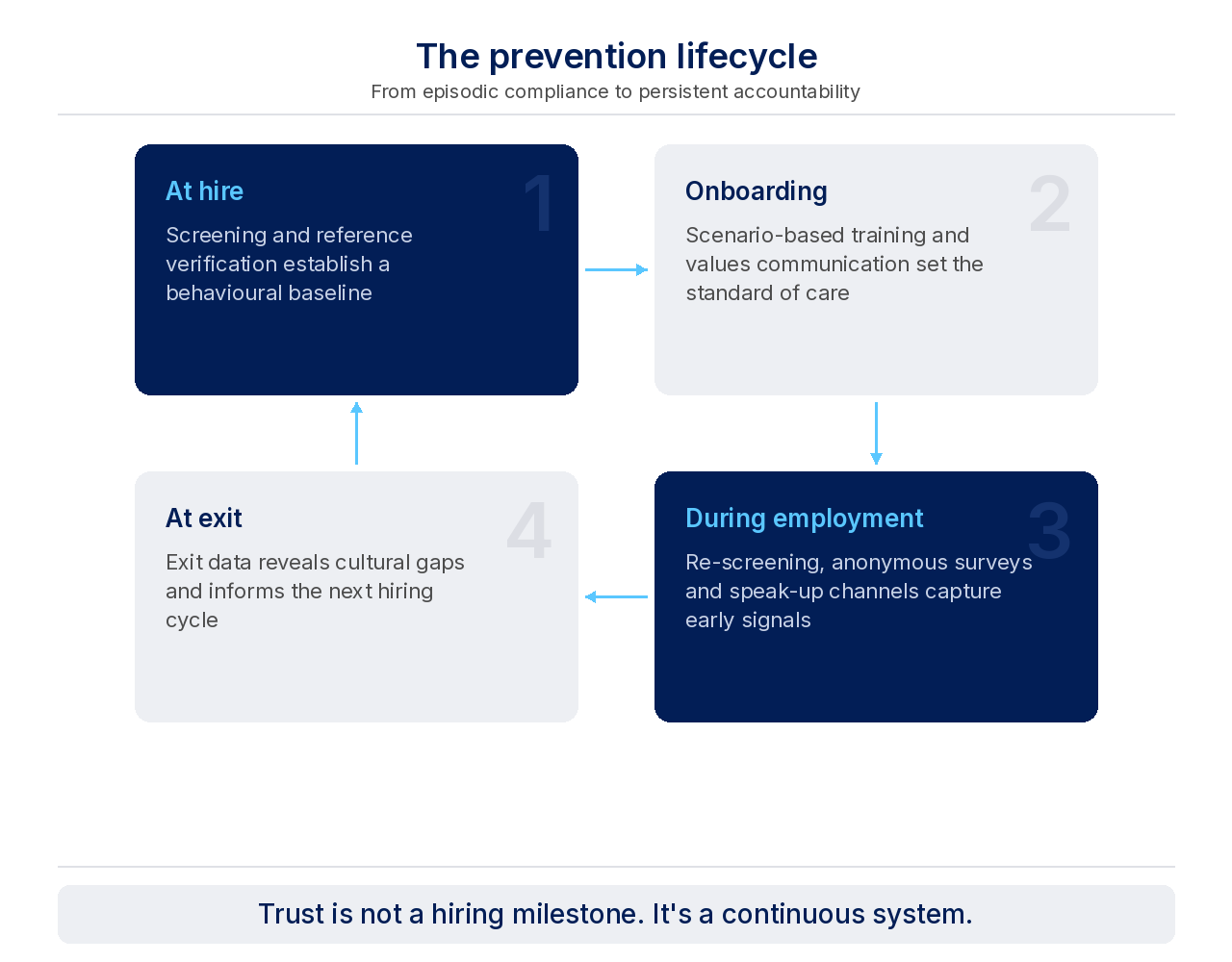
True prevention operates continuously, not episodically. Having an architecture built across the entire employee tenure ensures that "reasonable steps" are taken at every transition point:
- At Hire: Rigorous screening and reference verification establish a behavioural baseline before access is granted.
- Onboarding: Scenario-based, role-differentiated training and values communication set the "standard of care" from Day One, ensuring expectations are understood, not just signed.
- During Employment: Continuous monitoring through re-screening, anonymous surveys and "speak-up" channels helps to capture early signals - such as uncomfortable dynamics or subtle patterns of exclusion - before they escalate into a crisis.
- At Exit: Exit data serves as a lagging indicator, revealing cultural gaps that individual reports might have missed, ensuring those insights inform the next hiring cycle, preventing repetition.
The "Speak-Up" Channel as a Prevention Tool
The absence of complaints does not prove safety; often, it proves a lack of trust in the infrastructure. Currently, data suggests that over 40% of employees fear retaliation for reporting harassment.
An effective speak-up channel isn't just a mailbox for formal grievances; it is a signal capture tool. When workers trust the system to handle early-stage concerns proportionately, it allows leadership to intervene when a situation is merely "uncomfortable" rather than "unlawful." If reporting data is silent in high-risk areas, the infrastructure likely needs a redesign to encourage psychological safety.
Integration: Proving Your Duty of Care
Regulators now scrutinise whether your systems demonstrate ongoing risk identification and early intervention. Policies prove documentation; systems prove prevention.
When screening records, probation reviews, and "speak-up" reports live in disconnected silos, patterns remain invisible. Three people leaving the same team citing "cultural fit" could be a coincidence - or it could be an early signal of a hostile environment that was missed because the data wasn't connected.
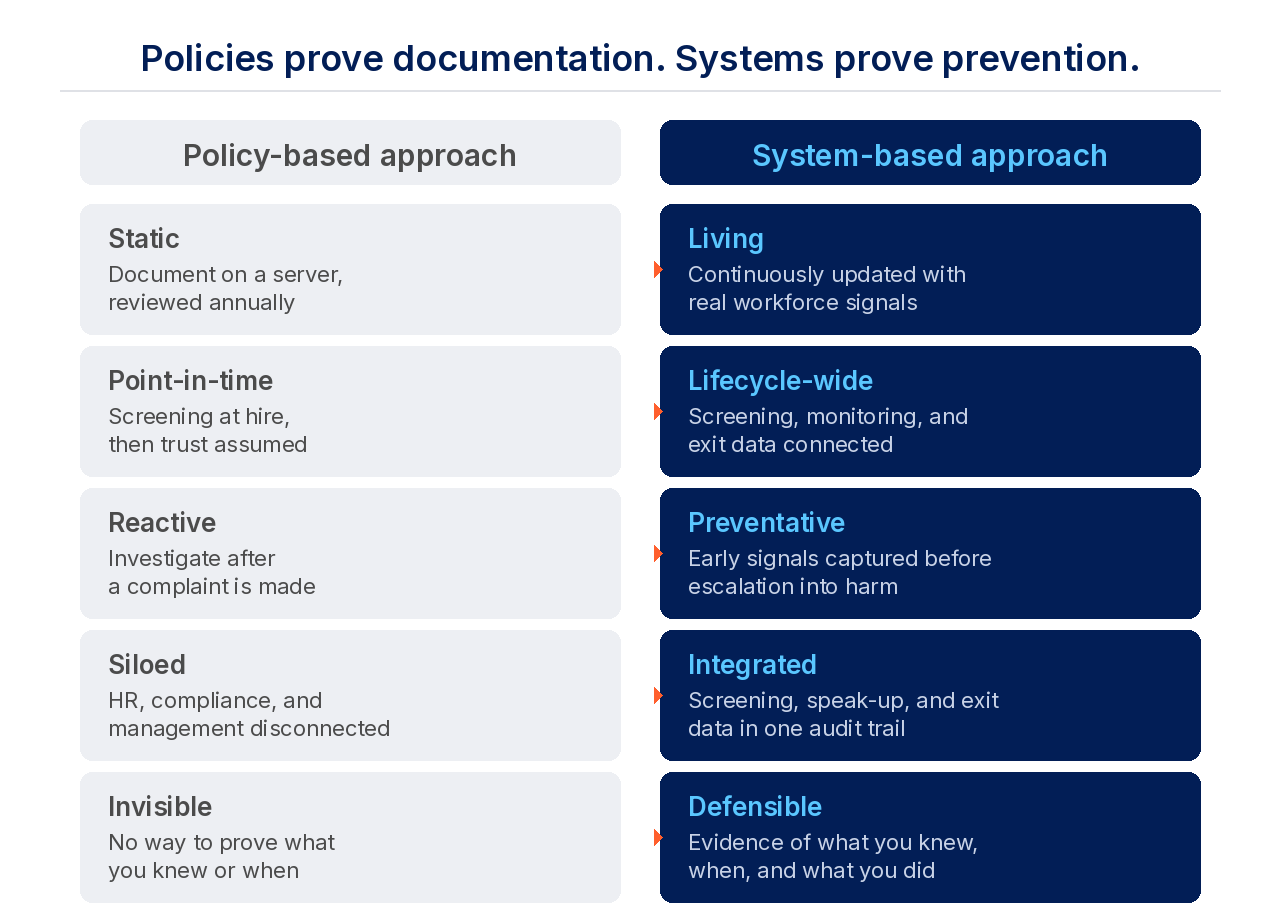
Bridging this disconnect requires moving toward integrated integrity systems. By unifying the "entry gate" (screening) with the "internal pulse" (monitoring and reporting), organisations move from guessing to knowing. This creates a defensible audit trail that proves to the board - and the regulator - that you didn't just have a policy; you had a functioning system of prevention.
Ultimately, the goal is to build a workplace where trust is visible and accountability is persistent. That is the hallmark of an organisation that has truly met its positive duty.
Veremark's workplace trust platform integrates screening, monitoring, speak-up channels and analytics into connected prevention architecture. The system demonstrates continuous accountability across the employee lifecycle, not just compliance at point of hire. Talk to us about building infrastructure that proves prevention.


.png)
FAQs

This depends on the industry and type of role you are recruiting for. To determine whether you need reference checks, identity checks, bankruptcy checks, civil background checks, credit checks for employment or any of the other background checks we offer, chat to our team of dedicated account managers.
Many industries have compliance-related employment check requirements. And even if your industry doesn’t, remember that your staff have access to assets and data that must be protected. When you employ a new staff member you need to be certain that they have the best interests of your business at heart. Carrying out comprehensive background checking helps mitigate risk and ensures a safer hiring decision.
Again, this depends on the type of checks you need. Simple identity checks can be carried out in as little as a few hours but a worldwide criminal background check for instance might take several weeks. A simple pre-employment check package takes around a week. Our account managers are specialists and can provide detailed information into which checks you need and how long they will take.
All Veremark checks are carried out online and digitally. This eliminates the need to collect, store and manage paper documents and information making the process faster, more efficient and ensures complete safety of candidate data and documents.
In a competitive marketplace, making the right hiring decisions is key to the success of your company. Employment background checks enables you to understand more about your candidates before making crucial decisions which can have either beneficial or catastrophic effects on your business.
Background checks not only provide useful insights into a candidate’s work history, skills and education, but they can also offer richer detail into someone’s personality and character traits. This gives you a huge advantage when considering who to hire. Background checking also ensures that candidates are legally allowed to carry out certain roles, failed criminal and credit checks could prevent them from working with vulnerable people or in a financial function.
Trusted by the world's best workplaces


APPROVED BY INDUSTRY EXPERTS
.png)
.png)


and Loved by reviewers


Transform your hiring process
Request a discovery session with one of our background screening experts today.