
Fast and compliant pre-employment identity checks in the Philippines


Hiring in the Philippines often moves quickly. Candidates may be applying across several employers, hiring teams may be working across borders, and roles can be filled within days. That speed creates pressure. Employers need to confirm that a candidate is who they say they are without slowing down the offer process or taking shortcuts with compliance.
That is where Philippines identity verification matters. A pre-employment identity check gives employers a clear, consistent way to confirm a candidate’s identity before they join the business. It helps reduce fraud risk, protects internal systems and customer data, and gives hiring teams confidence that the rest of the background screening process is based on accurate personal information.
Identity checks are not only useful for regulated industries. They are relevant for any employer hiring people into roles with access to company data, finance systems, customer accounts, confidential records or physical sites. A false or mismatched identity can affect payroll, contracts, access rights, background checks and future investigations. Getting this first step right makes the rest of the hiring process cleaner.
Why do identity checks matter for employers in the Philippines?
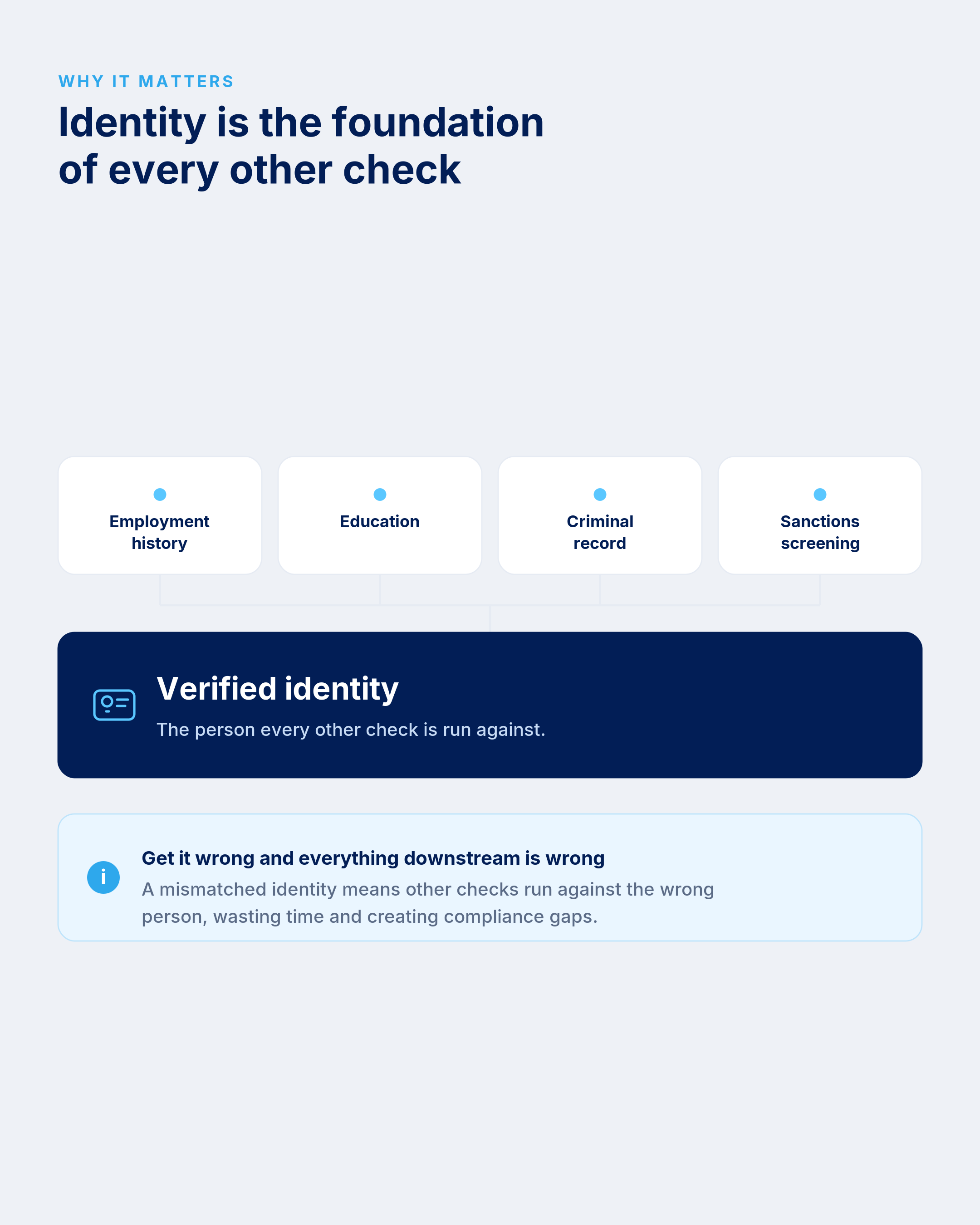
Employers in the Philippines face the same core hiring challenge as employers elsewhere: they must make decisions based on information supplied by the candidate. Most candidates are honest. Some are not. Identity checks help employers separate administrative errors from real risk.
A candidate may provide an outdated document, use a different name across records, omit part of their legal name, or submit a document that cannot be validated. In more serious cases, someone may use another person’s identity to pass a hiring process, hide previous records, avoid employment restrictions or gain access to sensitive work.
For employers, the cost is practical. If the identity is wrong, other checks may be run against the wrong person. Employment history, education records, criminal record checks and sanctions screening all rely on accurate identifying details. A small error at the start can waste time, produce unclear results or create compliance gaps.
A structured identity check also supports fairer hiring. Every candidate goes through the same process, the same evidence is requested, and decisions are based on verified information rather than subjective judgement. That matters for HR teams that need to show consistency, especially when hiring at scale.
Veremark’s Philippines background screening services help employers manage these checks online, giving teams a clearer process for local and international candidates.
What is a national identity check?
A national identity check confirms that a candidate’s identity document is valid and that the person presenting it matches the document. It is usually one of the first checks an employer runs because it confirms the basic details that other screening checks depend on.
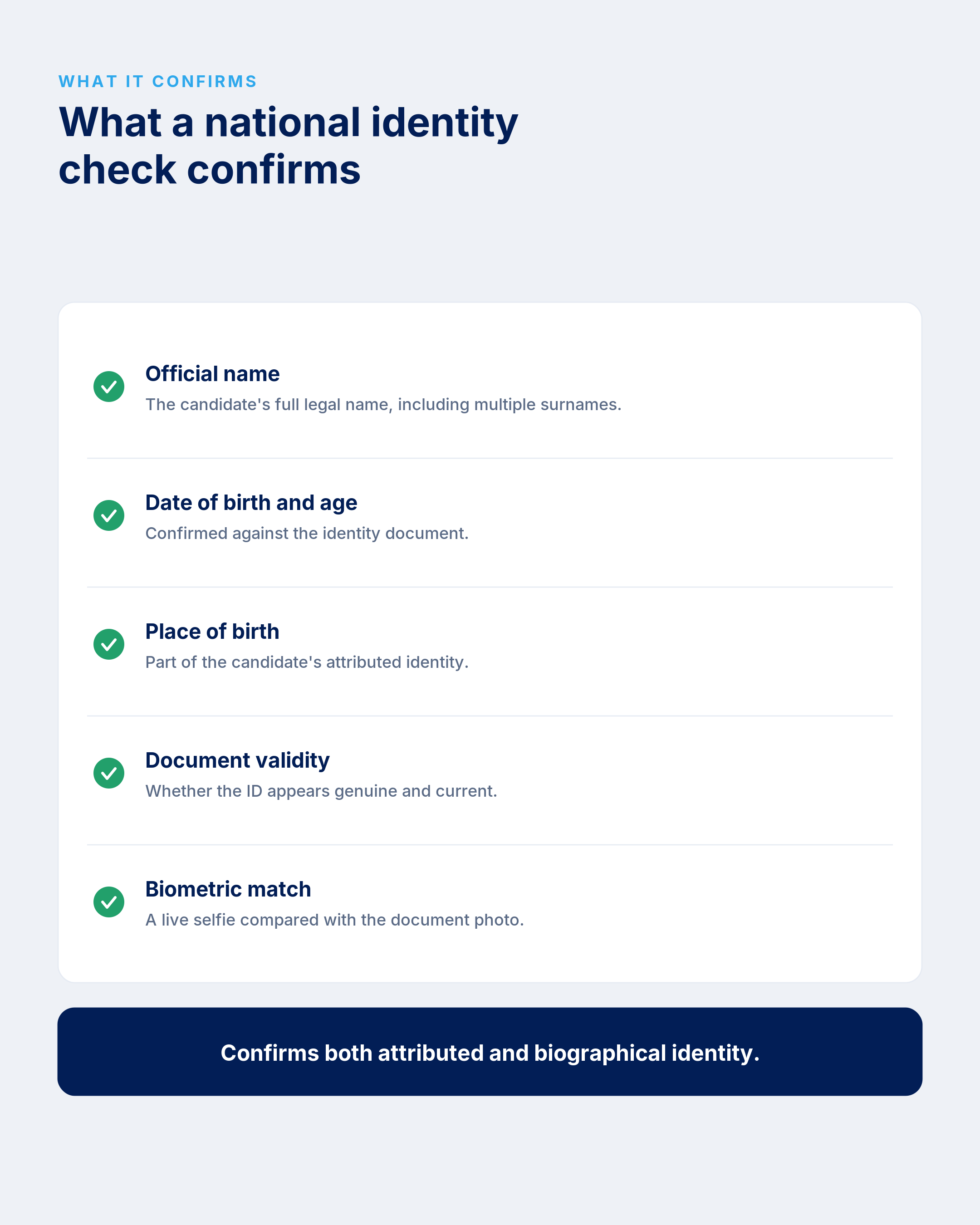
A typical identity check will confirm details such as the candidate’s official name, date of birth, age, place of birth and the validity of the identity document. It may also include a biometric match, where the candidate’s live image or selfie is compared with the image on their identity document.
Veremark’s identity check is designed to confirm both attributed identity and biographical identity. In practical terms, that means checking who the person is, whether their document appears valid, and whether the person completing the process is the same person shown on the document.
For employers, this is more useful than simply asking a candidate to email a copy of an ID. Emailing documents creates security risks, gives HR teams more manual admin, and leaves room for inconsistent review. A digital check gives the candidate a clear process and gives the employer a structured result.
What documents are used?
The documents used for Philippines identity verification are usually government-issued identity documents. The exact document accepted may depend on the check type, the candidate’s circumstances and the provider’s requirements.

Commonly used documents may include:
- Philippine national ID or PhilID
- Passport
- Driver’s licence
- Unified Multi-Purpose ID
- Social Security System ID
- Government Service Insurance System ID
- Professional Regulation Commission ID
- Voter’s ID
- Postal ID
The key point is that the document must be valid, clear and linked to the candidate. The details on the document should match the information used in the hiring process. Where there are name changes, spelling differences or multiple surnames, the candidate may need to provide additional context or supporting evidence.
Employers should avoid collecting more documents than they need. The aim is to confirm identity, not build an unnecessary file of personal data. A digital process helps limit access, reduce manual handling and keep the check focused on the information required.
How fast is the Veremark turnaround?
Speed matters because identity checks often sit at the start of the onboarding process. When they drag, contracts, system access, payroll setup and start dates can all be delayed.
With Veremark, employers can request a check in seconds online. Turnaround can take as little as just 2 days, depending on the case and whether the candidate submits the required information correctly. That gives hiring teams a practical way to keep momentum after offer stage without relying on manual document review.
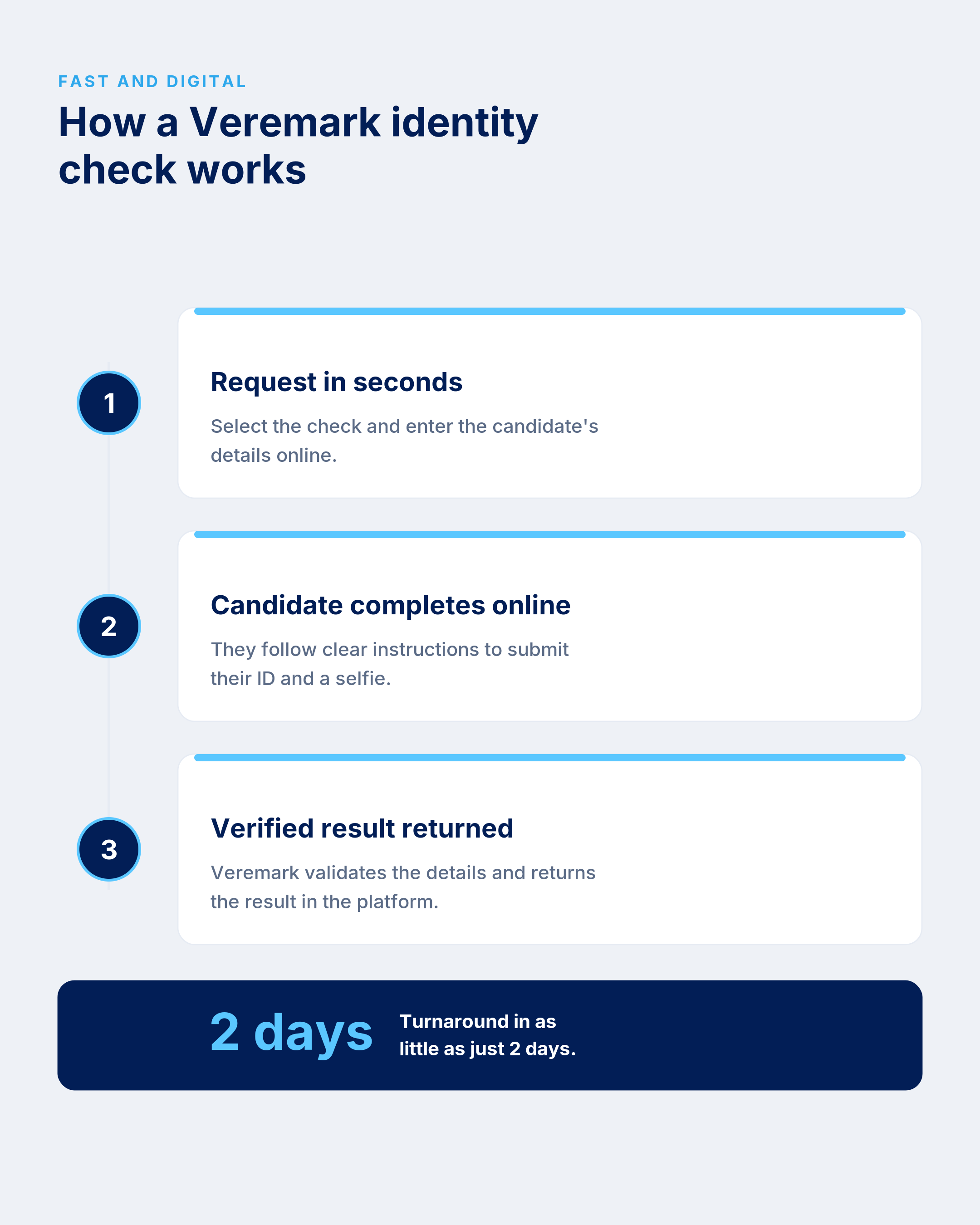
The process is simple. The employer selects the check, enters the candidate’s details, and the candidate receives instructions to complete their part online. Veremark then verifies the information and returns the result through the platform. Employers can also combine identity checks with wider pre-employment background checks, such as employment history checks, education verification, criminal record checks or sanctions screening where relevant to the role.
This matters for teams hiring in the Philippines from another country. A digital process reduces the need for back-and-forth emails, local paperwork and unclear status updates. It also helps regional HR teams apply one process across different hiring markets while still using country-specific checks.
Compliance starts with consent and clarity
A compliant process starts before the check is run. Employers should tell candidates what check is being requested, why it is needed, what information will be processed, and how the result will be used. Candidate consent should be recorded, and access to the result should be limited to people who need it for the hiring decision.
This is good practice for any employer handling personal data. Identity documents contain sensitive information. They should not sit in inboxes, shared drives or unsecured folders. Employers need a process that protects candidate data as well as the business.
Veremark’s digital screening model helps reduce manual handling by keeping the process online. Employers can request checks, track progress and receive results without building their own document collection process. For HR teams already managing multiple roles, regions and deadlines, that structure is valuable.
Where identity checks fit in the hiring process
Identity checks should happen early, usually after the candidate has accepted a conditional offer or at the point where the employer begins formal screening. Running the check too late can create avoidable delay. Running it inconsistently can create fairness and compliance issues.
For lower-risk roles, an identity check may be enough alongside standard onboarding checks. For higher-risk roles, it should sit alongside other screening. A finance role may require credit or sanctions checks. A role involving regulated work may need criminal record screening. A role requiring specific qualifications may need education or professional licence verification.
The identity check is the foundation. It confirms that the candidate linked to those checks is the right person.
This is why Philippines identity verification should not be treated as a minor admin step. It protects the integrity of every other check and gives employers a cleaner audit trail if questions arise later.
Order your Philippines identity check online
Employers hiring in the Philippines need a process that is fast, consistent and respectful of candidate data. Manual document collection is slow and easy to mishandle. A digital identity check gives HR teams a better way to confirm who they are hiring without holding up onboarding.
Veremark helps employers request checks online in seconds, with turnaround taking as little as just 2 days. You can also build identity checks into a wider screening package for roles that need deeper verification.
Order your check here: https://app.veremark.com/signup


.png)
FAQs

This depends on the industry and type of role you are recruiting for. To determine whether you need reference checks, identity checks, bankruptcy checks, civil background checks, credit checks for employment or any of the other background checks we offer, chat to our team of dedicated account managers.
Many industries have compliance-related employment check requirements. And even if your industry doesn’t, remember that your staff have access to assets and data that must be protected. When you employ a new staff member you need to be certain that they have the best interests of your business at heart. Carrying out comprehensive background checking helps mitigate risk and ensures a safer hiring decision.
Again, this depends on the type of checks you need. Simple identity checks can be carried out in as little as a few hours but a worldwide criminal background check for instance might take several weeks. A simple pre-employment check package takes around a week. Our account managers are specialists and can provide detailed information into which checks you need and how long they will take.
All Veremark checks are carried out online and digitally. This eliminates the need to collect, store and manage paper documents and information making the process faster, more efficient and ensures complete safety of candidate data and documents.
In a competitive marketplace, making the right hiring decisions is key to the success of your company. Employment background checks enables you to understand more about your candidates before making crucial decisions which can have either beneficial or catastrophic effects on your business.
Background checks not only provide useful insights into a candidate’s work history, skills and education, but they can also offer richer detail into someone’s personality and character traits. This gives you a huge advantage when considering who to hire. Background checking also ensures that candidates are legally allowed to carry out certain roles, failed criminal and credit checks could prevent them from working with vulnerable people or in a financial function.
Trusted by the world's best workplaces


APPROVED BY INDUSTRY EXPERTS
.png)
.png)


and Loved by reviewers


Transform your hiring process
Request a discovery session with one of our background screening experts today.