
Directorship checks: what they reveal and when to run one


A CV tells you where a senior candidate has worked. A directorship check tells you what the public registers already hold: the companies they run or have run, whether they're barred from being a director, and whether any of it conflicts with the role you're hiring for.
Why directorship checks matter

Disqualification isn't rare. The Insolvency Service disqualified 1,037 directors in 2024-25, for an average of 8.3 years. Someone who's been banned and takes a directorship anyway is committing a criminal offence, and if you appoint them to a director role, that becomes your problem too.
It's also about what a candidate didn't mention. In Veremark's 2025 data, directorship checks flag an undisclosed directorship or disqualified-officer status 1.5% of the time. That's a senior hire quietly running a business on the side, holding a stake that clashes with your interests, or sitting on a board they'd rather you didn't ask about. Directorships are a matter of public record, so there's no reason to be guessing.
What a directorship check reveals

The check pulls four things from official company registers: the directorships a candidate holds now and has held before, whether they appear on the disqualified directors register, any significant shareholdings, and any of those that conflict with the role. Together they show not just where someone has been, but what else they're tied to.
The conflict-of-interest risk

For senior, commercial and procurement roles, the sharper risk usually isn't a disqualification, it's a conflict you never see. A hire who sits on a competitor's board, a buyer with a stake in a supplier, a manager quietly running a rival on the side. None of it shows up on a CV, and all of it is easy to check against the register before you appoint.
A conflict isn't automatically a reason not to hire. Often it just needs declaring and managing. The value of the check is that you decide with it in front of you, rather than discover it after the person is in post.
Industries and roles that need a directorship check
It's aimed at senior and commercially sensitive appointments:
- Executive & board appointments: Directors, C-suite and non-executive directors
- Financial services & regulated firms: Where fit-and-proper and conflict rules apply
- Procurement & commercial roles: Buyers and budget holders who could favour a connected supplier
- Senior sales & business development: Hires who may hold interests in competitors or partners
- Startups & investors: Founders, advisers and anyone with overlapping company interests
- Professional & legal services: Partners and advisers with client and directorship overlaps
How Veremark runs it
The data is public, but pulling it together, checking the disqualified register and spotting the conflicts that matter to you is the work. Veremark does that in one place.

You select the directorship check and can flag conflicts against your own suppliers or competitors.
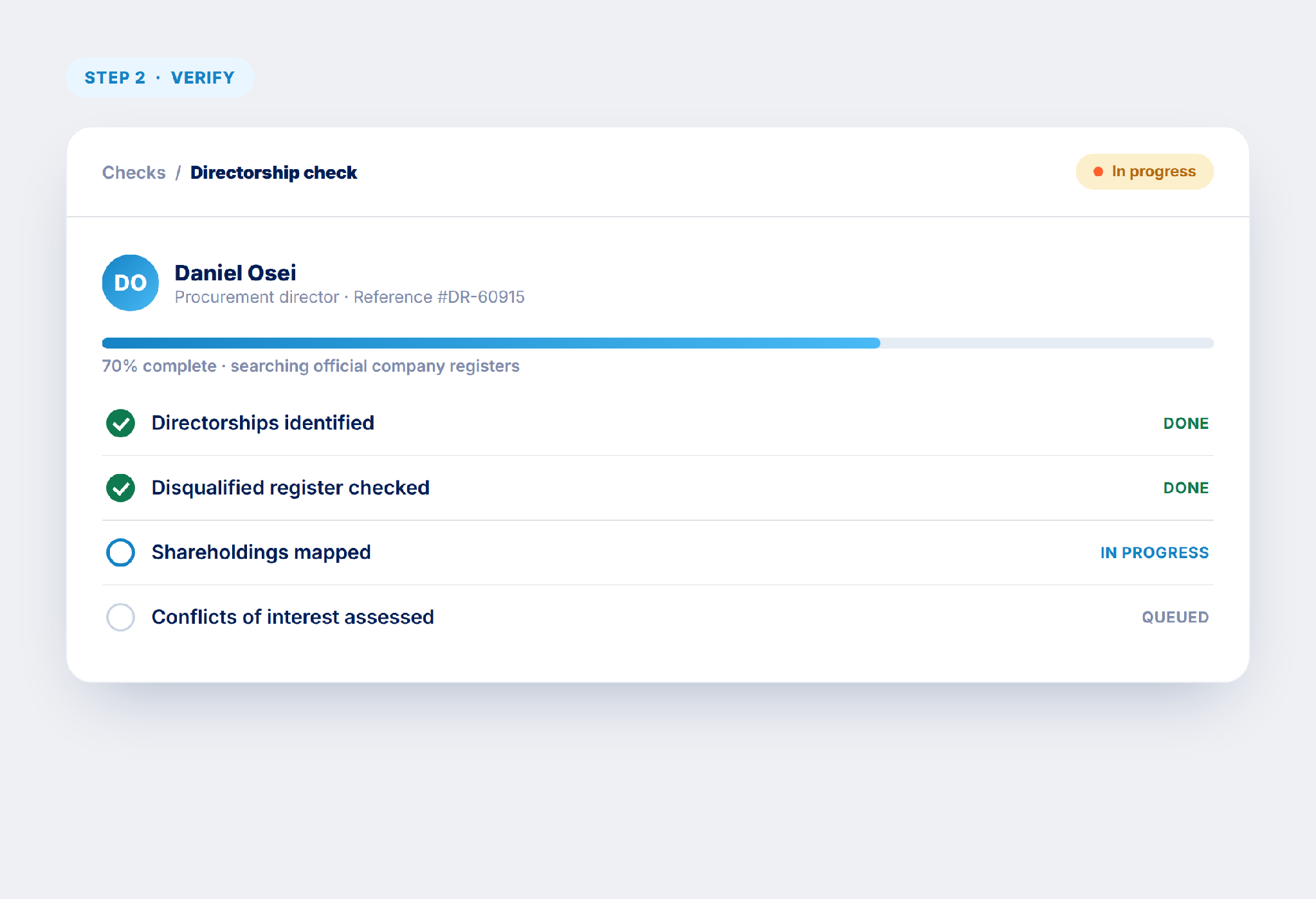
Veremark searches the official registers for directorships, disqualifications and significant shareholdings.

You get a clear report of what they hold, whether they're disqualified, and any conflict worth a conversation.
It's GDPR and PDPA compliant, pay-as-you-go with no lock-in, gives live status updates, and runs alongside the rest of your senior-hire screening.
The bottom line
A directorship check turns a senior candidate's public record into something you can actually see before you appoint: their directorships, whether they're barred, and any interest that clashes with the role. For board, finance and commercial hires, that's cheap insurance against a conflict or a disqualified director you'd otherwise meet the hard way. Veremark runs it from the official registers, quickly, and alongside every other check.
Sources
- Insolvency Service — enforcement outcomes 2024-25 — 1,037 directors disqualified; 8.3-year average
- gov.uk — check if someone is a disqualified director — the disqualified directors register is public
- Veremark 2025 Screening Benchmark — directorship checks flag 1.5% for undisclosed directorships and disqualifications

Read More


.png)

.png)
FAQs

This depends on the industry and type of role you are recruiting for. To determine whether you need reference checks, identity checks, bankruptcy checks, civil background checks, credit checks for employment or any of the other background checks we offer, chat to our team of dedicated account managers.
Many industries have compliance-related employment check requirements. And even if your industry doesn’t, remember that your staff have access to assets and data that must be protected. When you employ a new staff member you need to be certain that they have the best interests of your business at heart. Carrying out comprehensive background checking helps mitigate risk and ensures a safer hiring decision.
Again, this depends on the type of checks you need. Simple identity checks can be carried out in as little as a few hours but a worldwide criminal background check for instance might take several weeks. A simple pre-employment check package takes around a week. Our account managers are specialists and can provide detailed information into which checks you need and how long they will take.
All Veremark checks are carried out online and digitally. This eliminates the need to collect, store and manage paper documents and information making the process faster, more efficient and ensures complete safety of candidate data and documents.
In a competitive marketplace, making the right hiring decisions is key to the success of your company. Employment background checks enables you to understand more about your candidates before making crucial decisions which can have either beneficial or catastrophic effects on your business.
Background checks not only provide useful insights into a candidate’s work history, skills and education, but they can also offer richer detail into someone’s personality and character traits. This gives you a huge advantage when considering who to hire. Background checking also ensures that candidates are legally allowed to carry out certain roles, failed criminal and credit checks could prevent them from working with vulnerable people or in a financial function.
Trusted by the world's best workplaces


APPROVED BY INDUSTRY EXPERTS
.png)
.png)


and Loved by reviewers


Transform your hiring process
Request a discovery session with one of our background screening experts today.